Is Web Scraping Legal? Compliance Risks Explained
Web scraping has become essential for gathering pricing intelligence, monitoring competitors, and tracking market trends. As automation scales, one question keeps returning to boardrooms and compliance teams: is web scraping legal, and where does responsible data collection cross the line?
This guide breaks down where web scraping stands legally today, what actually creates risk, and how to build a compliant, defensible data collection process.
Here is the short answer: scraping publicly available data is generally legal in the United States, as confirmed by federal court rulings, but the method of access, the type of data collected, and the target website’s terms can still create liability under contract, copyright, or privacy law.
This guide draws on published court rulings, regulatory enforcement actions, and documented compliance frameworks rather than general assumptions.
None of this constitutes legal advice. Laws vary by jurisdiction and by data type, so treat this as a starting point for your own legal review, not a substitute for it.
Whether you scrape data in-house or rely on a managed service, the goal here is the same: help you collect data with confidence and stay on the right side of the law.
What Is Web Scraping and Why Does It Raise Legal Questions?
Web scraping is the automated collection of data from websites, typically using bots or scripts that read a page and extract structured information for later use.
Businesses use it for competitor price tracking, lead generation, market research, and real-time monitoring of listings, reviews, and product catalogs across large numbers of sites.
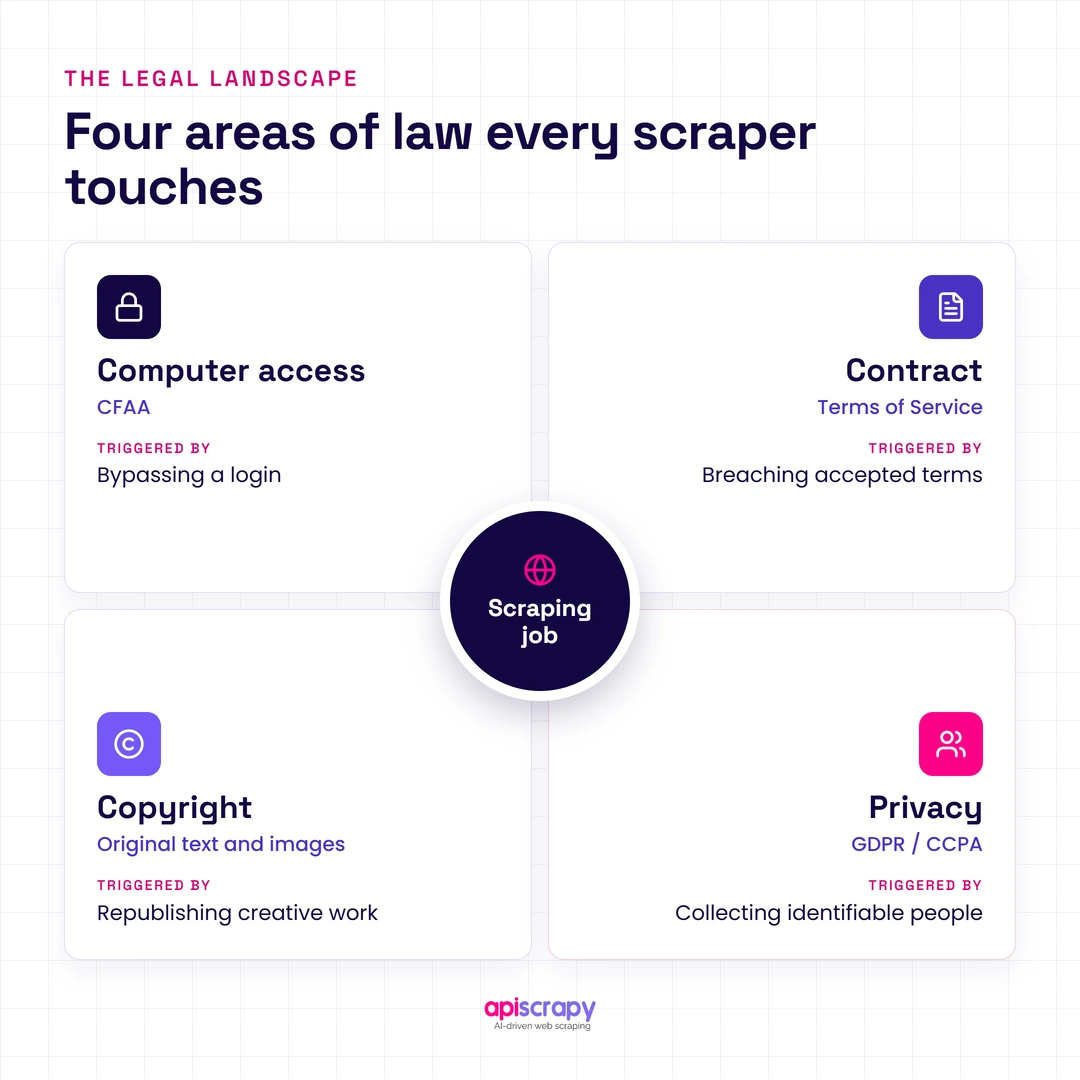
Legal questions arise because scraping sits at the intersection of computer access law, contract law, copyright law, and data privacy law. A single scraping job can touch all four depending on what is collected and how it is accessed.
Legal Boundaries and Compliance Risks
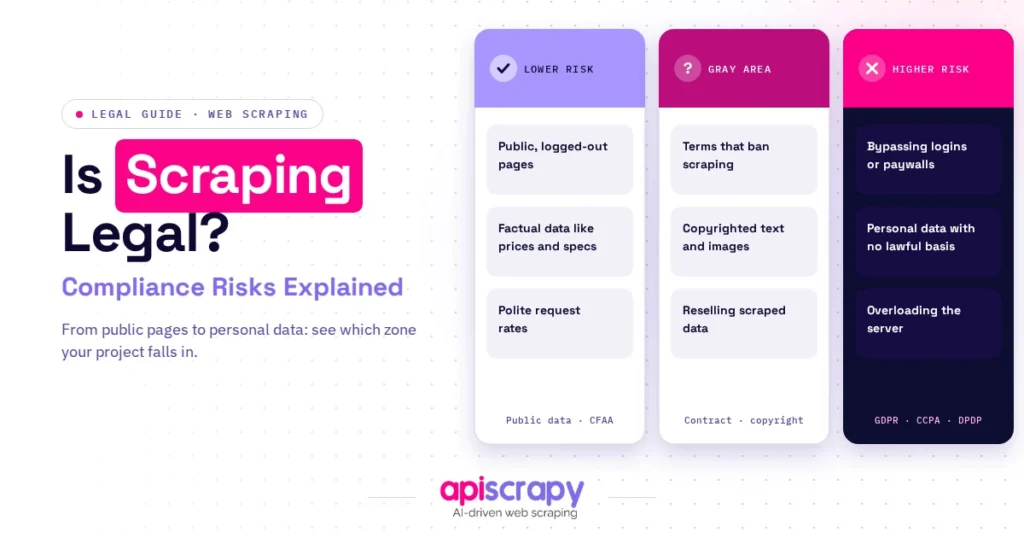
No single statute governs web scraping in the United States. Instead, courts and regulators apply a patchwork of existing laws depending on what was scraped and how.
The Computer Fraud and Abuse Act (CFAA) was written to punish computer hacking, and companies once used it to threaten scrapers with criminal liability. That changed with hiQ Labs, Inc. v. LinkedIn Corp., where the Ninth Circuit ruled that accessing publicly available web pages does not violate the CFAA, because there is no access barrier to bypass in the first place.
Data privacy regulations like the GDPR and CCPA apply regardless of whether data is public. If scraped data includes names, photos, or other information that identifies a person, collecting and processing it can require a lawful basis and consent under GDPR, even when the source page had no login wall.
Copyright and intellectual property law can apply when scraped content includes original text, images, or creative works, since collecting the data does not automatically grant the right to republish or resell it.
Terms of service still matter. Courts have repeatedly separated the CFAA question from the contract question, and violating a website’s terms can expose a business to a breach-of-contract claim even when no computer-access law was broken.
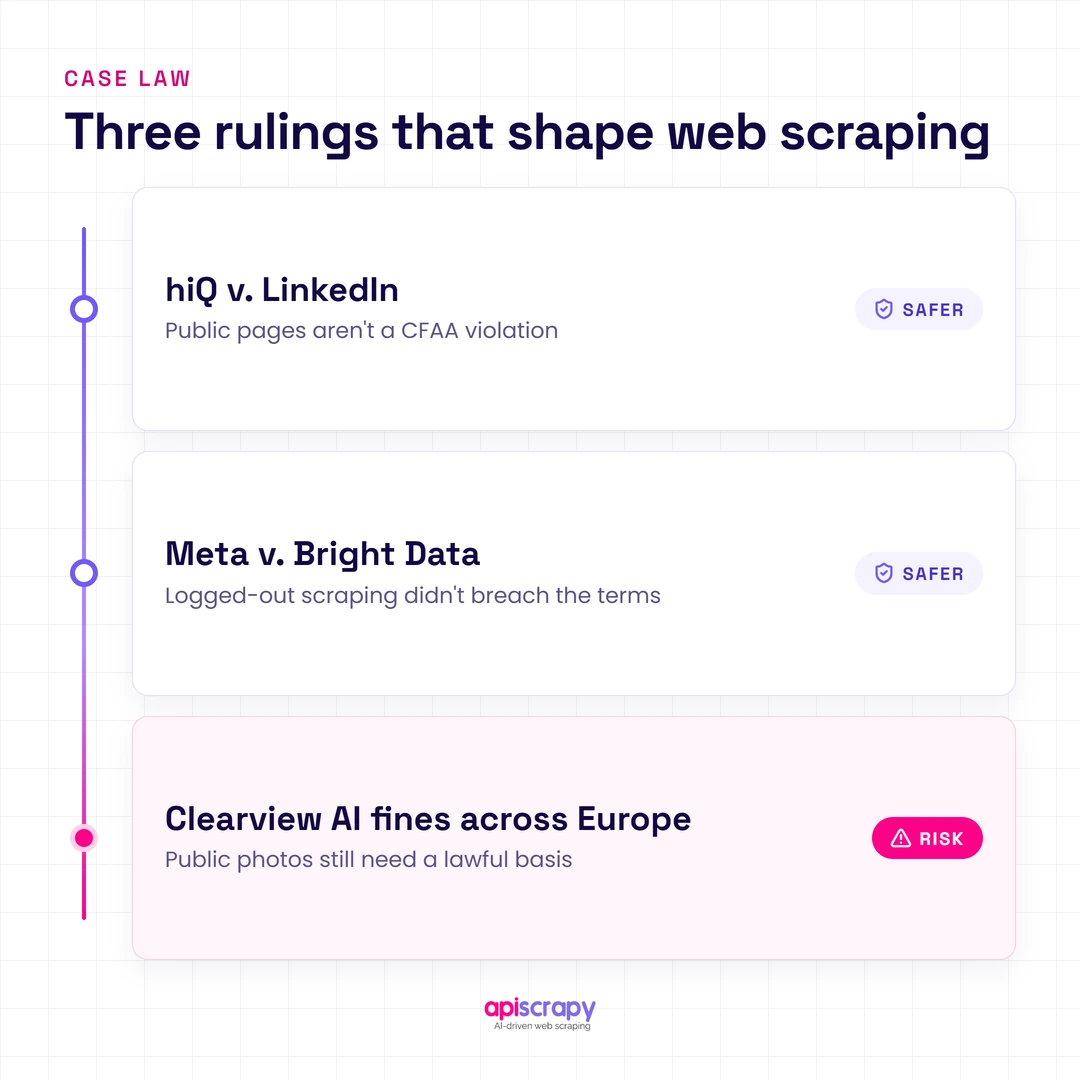
- hiQ Labs, Inc. v. LinkedIn Corp. (9th Cir.): scraping publicly available profile data does not violate the CFAA, since public pages have no authorization barrier to bypass.
- Meta Platforms, Inc. v. Bright Data Ltd. (N.D. Cal., 2024): scraping public Facebook and Instagram data while logged out did not breach Meta’s terms of service, since the scraper was never a bound account holder.
- Dutch, French, Italian, and UK data protection authorities fined Clearview AI tens of millions of euros combined for scraping public photos to build a biometric facial recognition database without a lawful basis.
Difference Between Legal vs Illegal Web Scraping
The line between legal and illegal scraping rarely comes down to the act of scraping itself. It comes down to what is accessed, how aggressively it is accessed, and what happens to the data afterward.
| Practice | Legal Approach | Illegal Approach |
|---|---|---|
| Data accessed | Public pages, no login required | Gated content behind authentication |
| robots.txt | Directives reviewed and respected | Ignored or deliberately bypassed |
| Server load | Rate-limited, off-peak requests | Aggressive crawling that degrades service |
| Personal data | Avoided, anonymized, or lawfully justified | Collected without consent or legal basis |
| Terms of service | Reviewed, contractual risk assessed | Knowingly violated after a cease-and-desist |
What Are the Best Practices for Responsible Scraping?
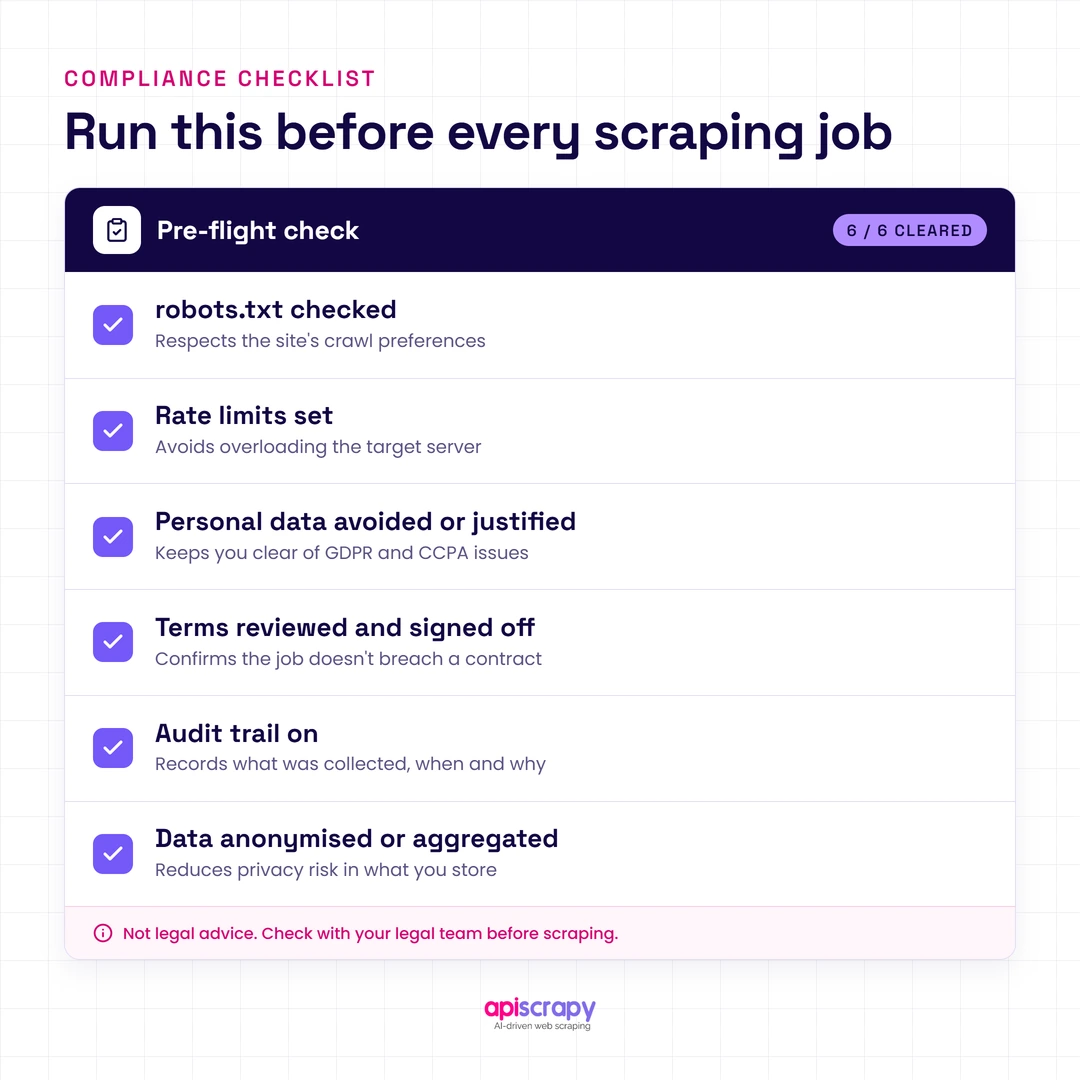
Responsible scraping is what keeps a data collection program both legal and sustainable over time. These practices matter more than any single line of code:
- Check and follow robots.txt directives before crawling any domain, even though they are not legally binding on their own.
- Rate-limit requests and scrape during off-peak hours so target servers are never degraded or overloaded.
- Avoid collecting personal data unless there is a clear, documented legal basis and a defined retention policy.
- Review each target site’s terms of service and flag high-risk sources for legal sign-off before scraping begins.
- Keep an audit trail of what was collected, when, and why, so compliance can be demonstrated if ever challenged.
- Anonymize or aggregate data wherever the use case allows it, rather than defaulting to raw personal-level collection.
Tired of Getting Blocked While Scraping the Web?
Even fully compliant scraping runs into a practical wall: IP blocks, CAPTCHAs, and anti-bot systems that treat every automated request as a threat, compliant or not.
This is where a managed data extraction service like APISCRAPY changes the equation. Instead of building and maintaining scraper infrastructure in-house, teams get structured, compliant data delivery handled end-to-end, with rate limiting, IP rotation, and robots.txt adherence built into the process.
Book a demo with APISCRAPY to see how a compliance-first data extraction service can replace your in-house scraping headaches.
How Can Businesses Scrape Data Without Legal Risks?
Conduct a Legal Review Before Scraping
Have legal counsel review target sites, data types, and jurisdictions before any large-scale scraping project begins, not after a cease-and-desist letter arrives.
Respect robots.txt and Terms of Service
Treat published crawling rules and site terms as the first filter for what is in scope, even where they are not always legally enforceable on their own.
Avoid Unnecessary Personal Data Collection
Scope every project to the minimum data needed for the business use case, and exclude personal identifiers whenever the analysis does not actually require them.
Use Compliant Scraping Infrastructure
Rely on infrastructure that enforces rate limits, honors access rules, and logs activity, whether that is built in-house or delivered through a managed service.
Document Data Governance Practices
Maintain written records of data sources, retention periods, and deletion processes so compliance can be demonstrated to regulators, partners, or auditors on request.
Think Twice Before Scraping Personal Data
Personal data carries a different risk profile than product listings or public pricing, because privacy regulators treat it as protected regardless of where it was found online.
The Clearview AI enforcement actions show what happens when this line is crossed. Dutch, French, Italian, and UK regulators each fined the company, citing unlawful processing of biometric data scraped from public photos without consent or a valid legal basis.
The safer path is to default to anonymized or aggregated data whenever the use case allows it, and to treat any personal-data project as one that needs a documented legal basis from the start.
Start Building Your Web Crawler Today
Conclusion
Web scraping itself is not illegal, and courts have consistently protected the right to collect publicly available data. What creates risk is scraping personal data without a legal basis, ignoring a site’s terms after being put on notice, or overwhelming servers with unthrottled requests.
Build compliance into the process from day one: respect access rules, minimize personal data, document your practices, and treat legal review as part of the workflow, not an afterthought.
Book a demo with APISCRAPY to get compliant, structured data delivered as a managed service, without carrying the legal and infrastructure risk of scraping in-house.
Frequently Asked Questions
Is web scraping legal if the data is publicly available?
Yes, in most cases. U.S. courts, most notably in hiQ Labs v. LinkedIn, have held that scraping data from public web pages does not violate federal computer-access law.
Public availability does not clear every risk, though. Copyright, contract, and privacy rules can still apply depending on what the data contains and how it gets used afterward.
Can you legally scrape a website that prohibits scraping in its Terms of Service?
It depends on your relationship to that site. Meta v. Bright Data found that logged-out scraping of public pages did not breach terms that only bound registered account holders.
Where you have accepted an account agreement or ignored a direct cease-and-desist notice, a breach-of-contract claim becomes far more likely, regardless of whether the data was public.
Is it legal to scrape and reuse copyrighted content, images, or product data from websites?
Scraping the data itself is usually the less risky step. Republishing or reselling copyrighted text, photos, or creative content without a license is where infringement claims typically arise.
Factual data points like prices or stock levels generally carry less copyright protection than original written or visual content, but reuse should still be reviewed case by case.
Can you legally scrape personal data from public websites?
Public visibility does not exempt personal data from privacy law. GDPR and similar regulations require a lawful basis for collecting information that identifies a person, public source or not.
The Clearview AI fines across multiple European regulators show how costly this gets when biometric or identifying data is scraped and processed without consent or justification.
What are the biggest legal and compliance risks businesses face when web scraping at scale?
The largest risks come from three sources: privacy law violations from personal data collection, contract claims from ignoring terms of service, and server strain from unthrottled requests. Scaling responsibly means building rate limits, data minimization, and legal review into the process from the start, rather than retrofitting compliance after a complaint or fine.