Ethical Web Scraping: A Guide to Responsible Scraping Practices
Web scraping has moved from a niche developer skill into a standard part of pricing intelligence, market research, and AI data pipelines. As more businesses depend on scraped data, the ethical and legal boundaries around collecting it have become harder to ignore.
This guide breaks down what ethical web scraping actually means, the core rules that keep a project defensible, and the engineering habits that turn good intentions into consistent practice. Whether you run scraping in-house or rely on a data extraction service, the same principles apply.
What is ethical web scraping?
Ethical web scraping means collecting publicly available data in a way that respects a website’s stated access rules, minimizes server load, protects personal information, and stays within legal and licensing limits, not just what is technically possible to extract.
What Does Ethical Web Scraping Actually Mean?
Ethical scraping is about intent and impact, not just the target site. Two services can pull the exact same page, but one respects rate limits and identifies itself honestly, while the other hits the server anonymously and grabs data it was never meant to collect.
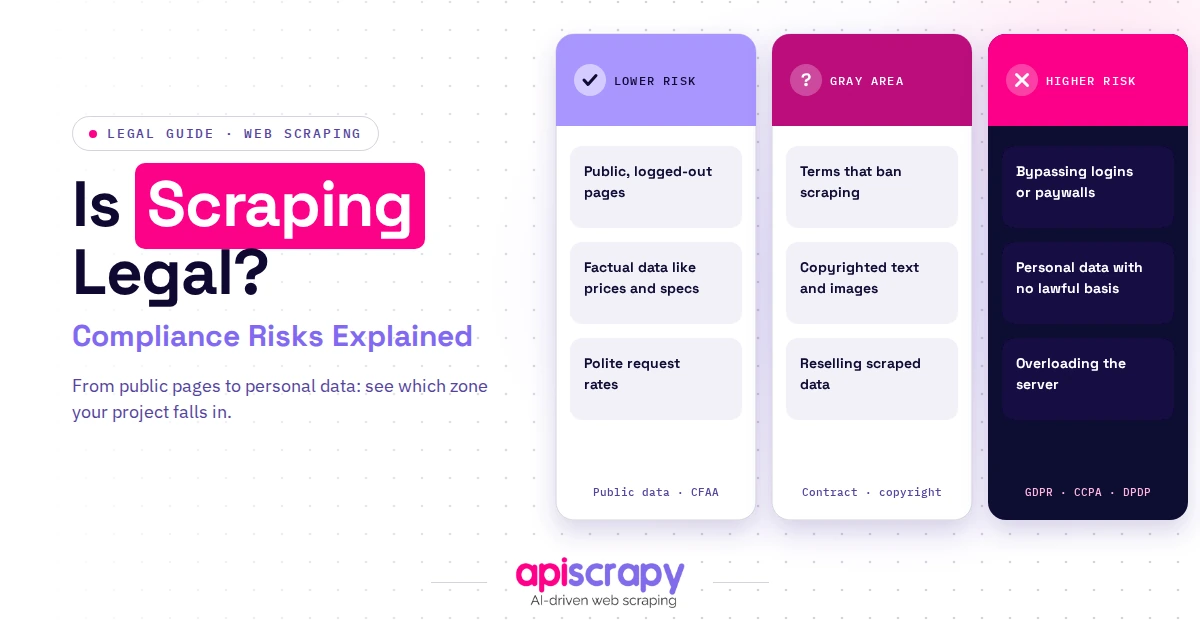
Public accessibility does not equal permission. A page loading without a login does not waive copyright, licensing terms, or privacy law, and regulators increasingly treat “it was public” as an incomplete defense on its own.
It helps to separate three different lenses before scraping anything at scale: legality, terms of service, and ethics. Something can be technically legal and still breach a site’s terms, and something can clear both bars and still feel wrong to the people whose data was collected. Responsible teams check all three, not just one.
In practice, this shows up as a simple pre-project checklist: confirm the legal basis for collecting the data, read the terms of service for that specific site rather than assuming a generic policy applies, and ask whether the collection would still feel acceptable if the site owner could see exactly how it was being used.
Core Rules for Responsible Web Scraping
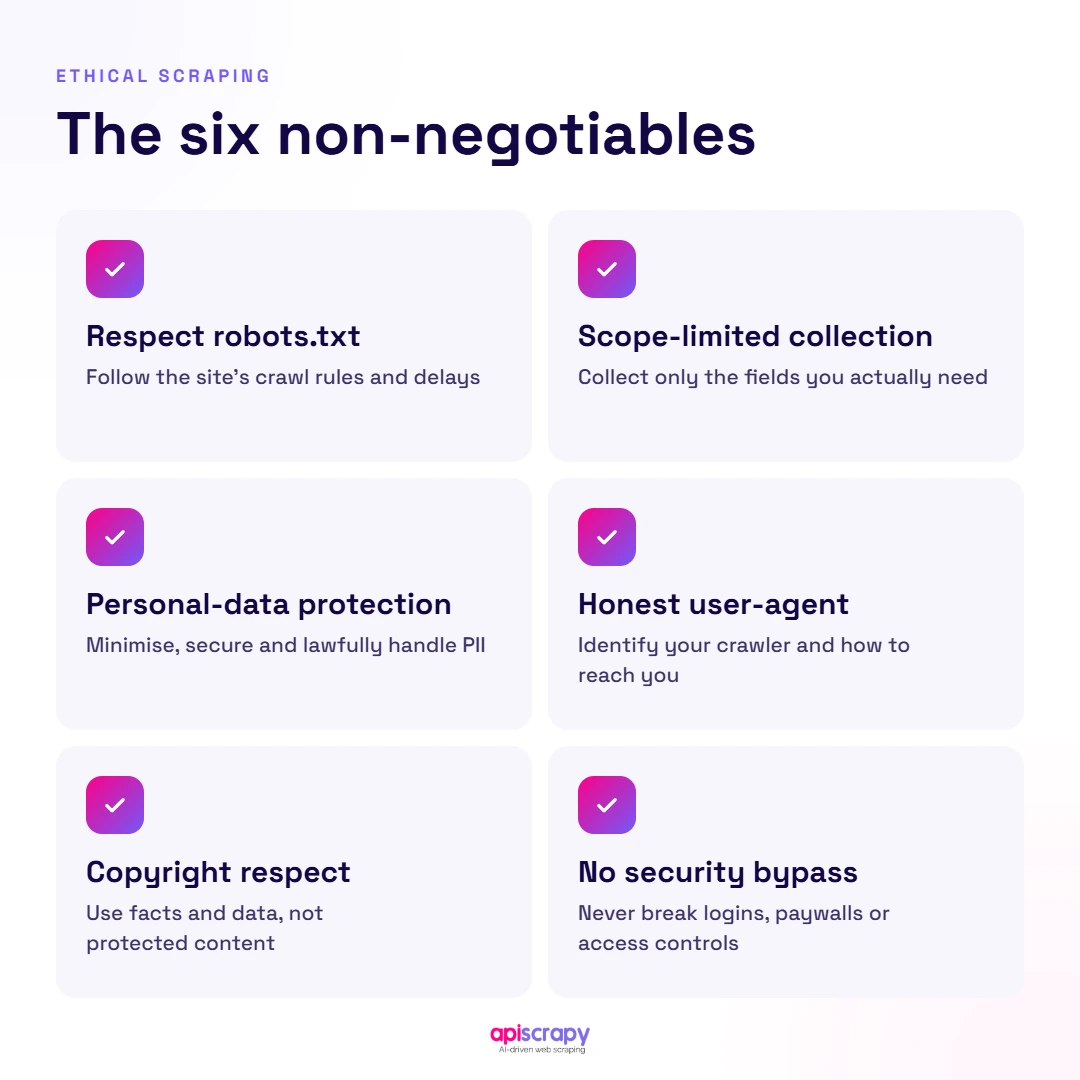
A short list of non-negotiables keeps most scraping projects out of trouble before they even start.
- Respect robots.txt and crawl-delay instructions. Treat disallow directives as binding, not a suggestion to work around.
- Collect only the data you need. Scope every project to a defined purpose instead of harvesting entire sites by default.
- Protect personal and sensitive information. Extra caution applies to identifiers, financial data, and health-related content.
- Identify your scraper honestly. A clear user agent with a contact method is a basic courtesy that builds trust with site owners.
- Respect copyright and licensing terms. Extracting content does not transfer the right to republish or resell it.
- Never bypass security controls. Logins, CAPTCHAs, and IP blocks are access decisions, not puzzles to defeat.
Engineering Practices That Build Ethics Into the Scraper
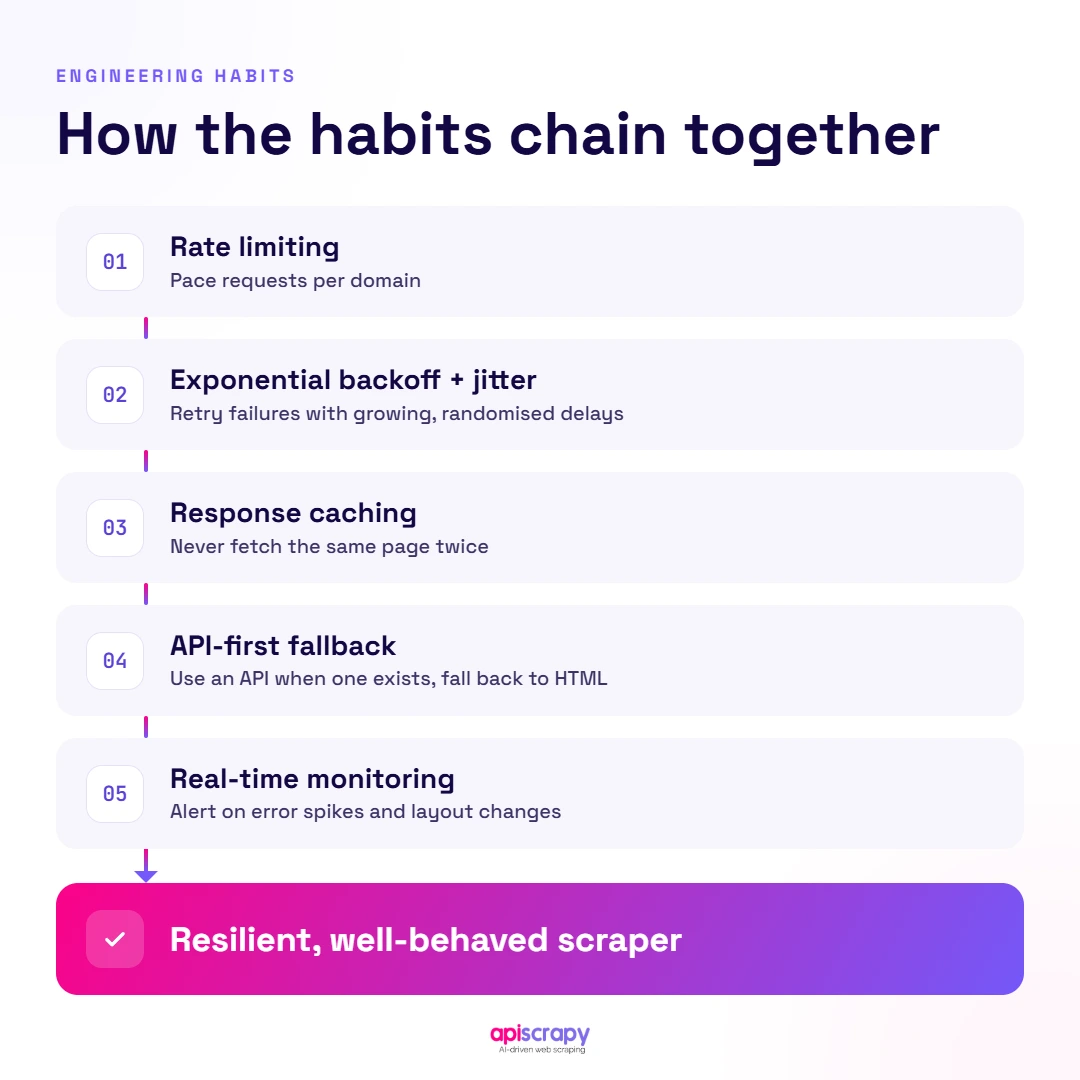
Good intentions do not scale without good engineering behind them. The rules above only hold up if the code enforces them automatically, rather than depending on someone remembering to be careful.
- Build rate limiting in from day one, scaled to the site’s size and observed response time.
- Use exponential backoff with jitter on retries instead of hammering a struggling server immediately.
- Cache responses so unchanged data is not re-fetched needlessly.
- Prefer an official API over scraping HTML whenever a site offers one.
- Monitor error rates and latency in real time, and let that monitoring trigger automatic slowdowns.
These habits protect the target site, but they also protect a scraping service’s own uptime and its long-term relationship with the sites it depends on. A service that gets blocked every few weeks because of aggressive crawling is not actually faster in the long run, it just fails more often and needs constant firefighting to stay online.
Start Building Your Web Crawler Today
Handling Rate Limits and Server Load
A 429 response or a visibly slowing site is a signal, not an obstacle. It should be read as an instruction to back off, not a wall to route around with more proxies or more parallel requests.
Start new crawls conservatively and scale up only once server behavior confirms the site can handle it. Avoid concurrent request spikes across distributed workers, since a coordinated crawl often causes more strain than a single, well-paced one.
Crawl-delay values published in robots.txt, where present, should override a scraper’s own defaults rather than being treated as a floor to shave down. If a site is publishing that number, it is telling you exactly how much load it can absorb comfortably.
Privacy and Data Protection in Web Scraping
Privacy is where legal exposure runs highest, and where 2026 has brought real change. On July 8, 2026, the European Data Protection Board adopted new guidance treating scraped personal data under the same rules as any other collection method, requiring a documented legitimate interest assessment and upfront data minimization before scraping begins.
In practice, that means minimizing what you collect, avoiding sensitive categories outright, defining retention windows, and securing whatever you do store the same way you would any other regulated dataset. Anonymize or aggregate wherever the analysis does not genuinely need individual-level detail.
It is worth building a short data map for every scraping project before it starts: what fields are being collected, why each one is needed, how long it will be kept, and who inside the team can access it. This single document tends to answer most compliance questions before they are even asked.
What Changed With the EU AI Act in 2026
Since August 2, 2026, the EU AI Act’s obligations for general-purpose AI providers have been fully in force. Providers must publish a detailed summary of their training data sources and put technical measures in place that honor robots.txt and text-and-data-mining opt-outs under copyright law. Fines for non-compliance can reach into the millions, and the obligation sits on top of GDPR rather than replacing it.
For any service that scrapes at scale or feeds data into AI systems, documenting where data came from, when it was collected, and what license applied is no longer optional paperwork. It is now part of what regulators expect to see on request.
None of this replaces good judgment. A published training-data summary or a signed data processing agreement will not fix a project that was careless about what it collected in the first place. The paperwork is a byproduct of doing the collection responsibly, not a substitute for it.
Conclusion
Ethical web scraping is not a single rule to check off. It is a habit that spans legal awareness, engineering discipline, and basic respect for the people behind the data.
As scraping and AI data collection keep scaling through 2026, that discipline is what separates a data extraction service worth trusting from one that eventually gets blocked.
If you want data collected the right way from the start, book a demo with APISCRAPY and see how a compliance-first scraping service works in practice.
Frequently Asked Questions
What data should you never scrape?
Avoid private personal data, sensitive categories like health or financial records, and anything sitting behind a login or security control. The legal and reputational risk of these categories outweighs almost any data value.
How is the EU AI Act changing scraping rules in 2026?
Since August 2, 2026, general-purpose AI providers must publish a detailed summary of their training data sources and show that collection respected copyright opt-outs. Documenting provenance is now a compliance requirement, not just good practice.
Why does ethical scraping matter even when it's legal?
Something can clear every legal bar and still damage trust with the sites and people it affects. Sites that feel abused respond with harder blocks, which raises costs for every scraper that follows.
How does GDPR apply to publicly available data?
GDPR protections apply to personal data regardless of whether it was found on a public page. Purpose limitation, lawful basis, and data subject rights still apply to scraped personal information.
What happens if you violate a site's terms of service?
Consequences range from IP bans and account termination to breach-of-contract claims, depending on the terms' language. Repeated violations can also be used as evidence of bad faith in unrelated disputes.