5 Best Web Scraping APIs (Fast, Easy to Use, Tested)
Web scraping APIs used to mean scripts that broke every time a target site changed its layout. Most growing teams have moved past that. They lean on a web scraping API instead, letting someone else manage proxies, browser rendering, and CAPTCHA-solving while they focus on the data itself.
This guide compares five web scraping APIs worth shortlisting this year, based on how they handle real-world targets, what they cost at scale, and how quickly a developer can go from signup to a working request. We looked at:
- Independent and self-reported benchmark data on success rates and response times
- Published pricing pages, tested against a realistic mixed workload
- Documentation quality and how fast a first request actually works
- Public reviews and community feedback from developers using each service day to day
APISCRAPY one of the services featured below, is referenced here as a vendor in this space. We’ve aimed to keep the comparison fair and grounded in how each service actually performs.
Our goal isn’t to crown one “best” API for everyone. It’s to help you match a service to your actual workload, whether that’s a handful of product pages a day or millions of requests against sites that actively fight back.
All service descriptions and comparisons rely on publicly available documentation, verified customer feedback, and documented performance outcomes.
Vetting Methodology: How We Evaluated These Web Scraping APIs
We scored every provider on the same six weighted criteria, drawing on public vendor documentation, published pricing pages, and verified G2 and Capterra reviews.
| Criterion | Weight | What We Checked | Evidence Source |
|---|---|---|---|
| Data Coverage and Freshness | 25% | Dataset breadth, refresh frequency, and what actually triggers a re-collection | Vendor documentation and product pages |
| Delivery and Integration | 20% | Support for API, cloud share, batch, and webhook delivery, plus fit with warehouses, BI tools, and CRMs | API docs and integration listings |
| Compliance and Data Governance | 15% | Written GDPR and CCPA handling, along with SOC 2, ISO 27001, or equivalent certifications | Public trust centers and security pages |
| Pricing Transparency and Scalability | 15% | Published tiers, contract minimums, credit expiration, and renewal terms | Pricing pages and reviewer-reported quotes |
| Verified Customer Sentiment | 15% | Recurring praise and complaints, weighed separately for small business and enterprise buyers | Verified G2 and Capterra reviews |
| Support and SLAs | 10% | Named account contacts, written uptime guarantees, and response times | SLA documentation and support-related reviews |
| Total | 100% |
Need a Web Scraping API? Compare Your Options
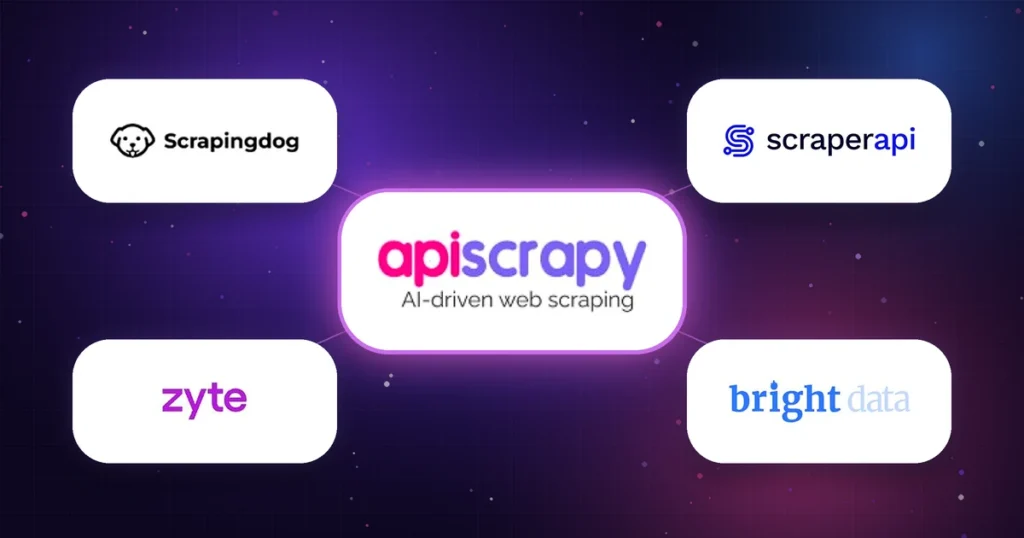
| Service | Best For | Success Rate | Reviews & Ratings | Key Advantage | Starting Price |
|---|---|---|---|---|---|
| Apiscrapy | End-to-end scraping + ready-to-use data feeds | High reliability on e-commerce & business targets | ~4.6/5 average across review services | No-code scraper builder plus managed DaaS delivery | Start for $1 |
| Bright Data | Large-scale, heavily protected targets | Among the highest in independent benchmarks | ~4.6/5 on G2 (300+ reviews) | Largest proxy network and 400+ pre-built scrapers | From ~$499/mo (enterprise-leaning) |
| ScraperAPI | Simple, budget-friendly general scraping | Strong on unprotected/lightly protected sites | ~4.5/5 on Capterra/G2 | Straightforward endpoint, easy first integration | Free tier, paid from ~$49/mo |
| Zyte | Teams already using the Scrapy framework | Solid mid-tier reliability | ~4.3/5 on G2 | AI-assisted extraction without writing selectors | Free trial, custom quote pricing |
| Scrapingdog | Cost-conscious teams needing speed | Consistently high in third-party speed tests | ~4.7/5 on G2/Capterra | Low per-request cost at volume | Free credits, paid from a few cents per 1K calls |
How to Choose the Best Web Scraping API?
Picking a web scraping API isn’t just about the lowest price per request. The right fit depends on what you’re scraping, how often, and what happens downstream with the data.
Success Rate & Data Accuracy
A cheap API that fails on 1 in 5 requests isn’t actually cheap once you factor in retries, missing data, and engineering time spent chasing gaps. Look for providers that publish real success-rate numbers rather than vague marketing claims.
Pricing & Scalability
Headline pricing is often misleading. Credit multipliers for JavaScript rendering or premium proxies can quietly double or triple your real cost per successful request at scale.
Compliance & Legal Safety
Data privacy rules like GDPR and CCPA, plus each target site’s own terms of service, matter more as scraping programs grow. Providers with documented compliance practices reduce risk for regulated or enterprise use cases.
Support & Documentation Quality
When something breaks at 2 a.m., responsive support and clear docs are the difference between a five-minute fix and a lost day.
Best Web Scraping APIs to Try
1. Apiscrapy
Apiscrapy is a web scraping API provider designed for teams that need more than just raw HTML responses. It combines a no-code scraper builder with managed data delivery, helping both technical and non-technical teams access structured, ready-to-use data without having to build and maintain scraping infrastructure.
Key features:
- No-code scraper builder alongside a developer-friendly API for flexible use
- Built-in data cleaning and structuring, reducing manual parsing work
- Anti-bot handling and IP rotation tuned for e-commerce and business data targets
- Managed Data-as-a-Service option for teams that want delivered datasets, not just raw responses
- Free tier available for testing before committing to a paid plan
- APISCRAPY’s ISO 27001, ISO 9001, GDPR, HIPAA and SOC 2 certified, and brands like Meta and Mastercard already trust it for their data needs.
Pros:
- Handles data cleaning and structuring, not just retrieval, cutting post-processing time
- No-code option makes it accessible to non-developers, not just engineering teams
- Strong fit for e-commerce, pricing, and business intelligence data specifically
Cons:
- Smaller pre-built scraper library than the largest legacy proxy networks
- Managed DaaS delivery may be more than teams needing only occasional, one-off pulls require
Pricing: Apiscrapy offers a free tier for testing, with paid plans starting from roughly $1 depending on request volume and whether you need the managed data-delivery option.
2. Bright Data
Bright Data is a web scraping API provider built for teams that need reliable data extraction at scale. It combines a powerful proxy network with advanced scraping infrastructure, helping businesses collect data from complex and heavily protected websites with greater efficiency.
Key features:
- Very large residential, datacenter, and mobile proxy pools across many countries
- Hundreds of pre-built, maintained scrapers for major services
- Strong documented compliance posture, useful for enterprise procurement
Pros:
- Consistently ranks among the highest success rates in independent benchmarks
- Broadest network scale, useful for heavily protected or high-volume targets
- Documented compliance certifications ease enterprise procurement approval
Cons:
- Pricing and contract structures are built for larger budgets, not small projects
- Steeper learning curve and more configuration than simpler point-to-point APIs
Pricing: Entry-level access starts in the low hundreds of dollars per month, with serious enterprise usage commonly running from roughly $499/month upward, plus usage-based charges.
3. ScraperAPI
ScraperAPI is a well-established web scraping API provider designed to simplify data extraction for developers and businesses. It handles key scraping challenges such as proxy rotation, browser rendering, and request management, allowing users to retrieve web data without building their own scraping infrastructure.
Key features:
- Simple, well-documented endpoint that’s fast to integrate
- Solid performance on unprotected or lightly protected sites
- Free tier for testing before upgrading to a paid plan
Pros:
- One of the fastest services to get a first working request out of the box
- Reliable on straightforward, lightly protected targets at a reasonable price
- Large user base means abundant tutorials and community troubleshooting
Cons:
- Returns raw HTML only, so parsing and structuring is left entirely to you
- Success rate drops noticeably on tougher, heavily defended sites
Pricing: A free tier covers limited monthly requests, with paid plans starting around $49/month and scaling up based on request volume and rendering needs.
4. Zyte
Zyte is a web scraping API provider designed for teams that need scalable and reliable data extraction infrastructure. Built around the open-source Scrapy ecosystem, it provides managed scraping solutions that help developers collect web data efficiently without handling the complexities of proxies, browsers, and infrastructure management themselves.
Key features:
- Deep integration with the Scrapy ecosystem for existing codebases
- AI-assisted extraction that can pull structured data without manually written selectors
- Attention to compliance, which suits regulated industries
Pros:
- Near-seamless fit for teams already invested in the Scrapy framework
- AI-powered extraction reduces manual selector maintenance over time
- Compliance-conscious approach suits regulated or enterprise environments
Cons:
- Response times sit in the mid-tier, slower than several competitors here
- Custom, quote-based pricing for most serious plans slows down getting started
Pricing: Zyte offers a 14-day free trial, but most production-level plans require a custom quote rather than fixed, published pricing.
5. Scrapingdog
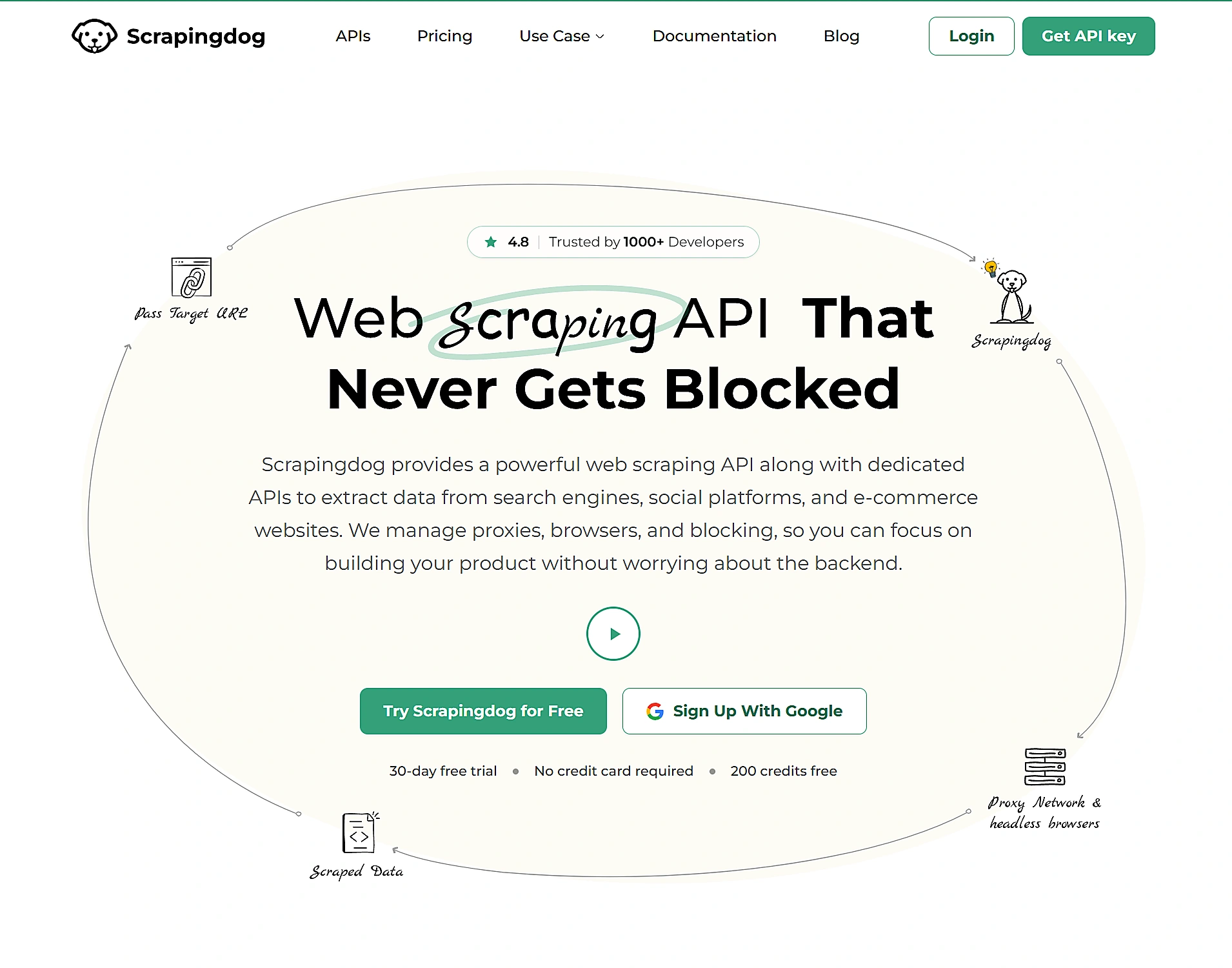
Scrapingdog is a web scraping API provider focused on delivering a simple and cost-effective solution for businesses and developers that need reliable data extraction. It helps users collect web data efficiently by managing key scraping challenges such as proxies, browser rendering, and request handling.
Key features:
- Competitive response times in independent speed comparisons
- Low cost per request at higher volumes
- Clear documentation aimed at fast developer onboarding
Pros:
- Among the lowest per-request costs once volume scales up
- Fast, consistent response times in third-party speed tests
- Straightforward setup with 24/7 support in most plans
Cons:
- Smaller feature set than full services — no marketplace or workflow automation
- Less suited to teams needing pre-built, site-specific scrapers out of the box
Pricing: Free credits are available on signup, with paid usage starting at a few cents per 1,000 calls and dropping further at higher volumes.
What Are People on Reddit Saying?
Recurring threads there echo what shows up in the table above: cheaper services win on cost per call, but teams scraping harder targets consistently report paying more for reliability rather than fighting failed requests and retries.
You can browse ongoing discussions on r/webscrapingapi for real-time developer opinions on specific services before you commit to one.
Start Building Your Web Crawler Today
Conclusion
There’s no single “best” web scraping API for every team. The right choice depends on your scale, your budget, and whether you want raw HTML or ready-to-use structured data.
If you’re just starting out, test two or three options against your actual target sites before committing to a paid plan. Free tiers exist precisely so you don’t have to guess.
If you’d rather skip the trial-and-error, book a demo with Apiscrapy and we’ll walk through your exact use case, data volume, and target sites to show you what a managed setup would actually look like.
Frequently Asked Questions
What is a web scraping API?
A web scraping API is a service that fetches web page data on your behalf, handling proxies, rendering, and bot-detection bypass automatically.
Can I try web scraping APIs for free before paying?
Yes, most providers covered here offer a free tier or trial credits, typically ranging from a few hundred to several thousand requests.
Do I need technical skills to use these APIs?
Services like Apiscrapy also offer no-code builders, making them accessible to marketing or analytics teams without a dedicated developer.
What is the difference between a web scraping API and building your own scraper?
Building your own scraper offers full control but requires ongoing management of proxies, rendering, and site changes. A web scraping API reduces engineering effort by handling infrastructure, maintenance, and downtime risks.
Which web scraping API had the highest success rate in 2025?
Independent benchmarks from 2025 generally placed large-scale providers with extensive proxy networks at the top for success rate on heavily protected sites.