Real Estate Investor Leads: How to Find Them with Property Data
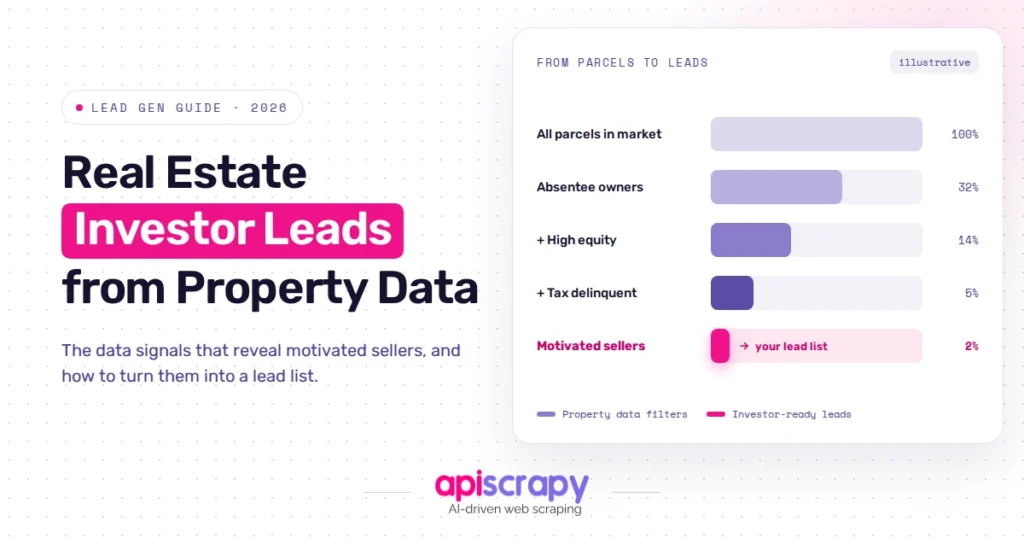
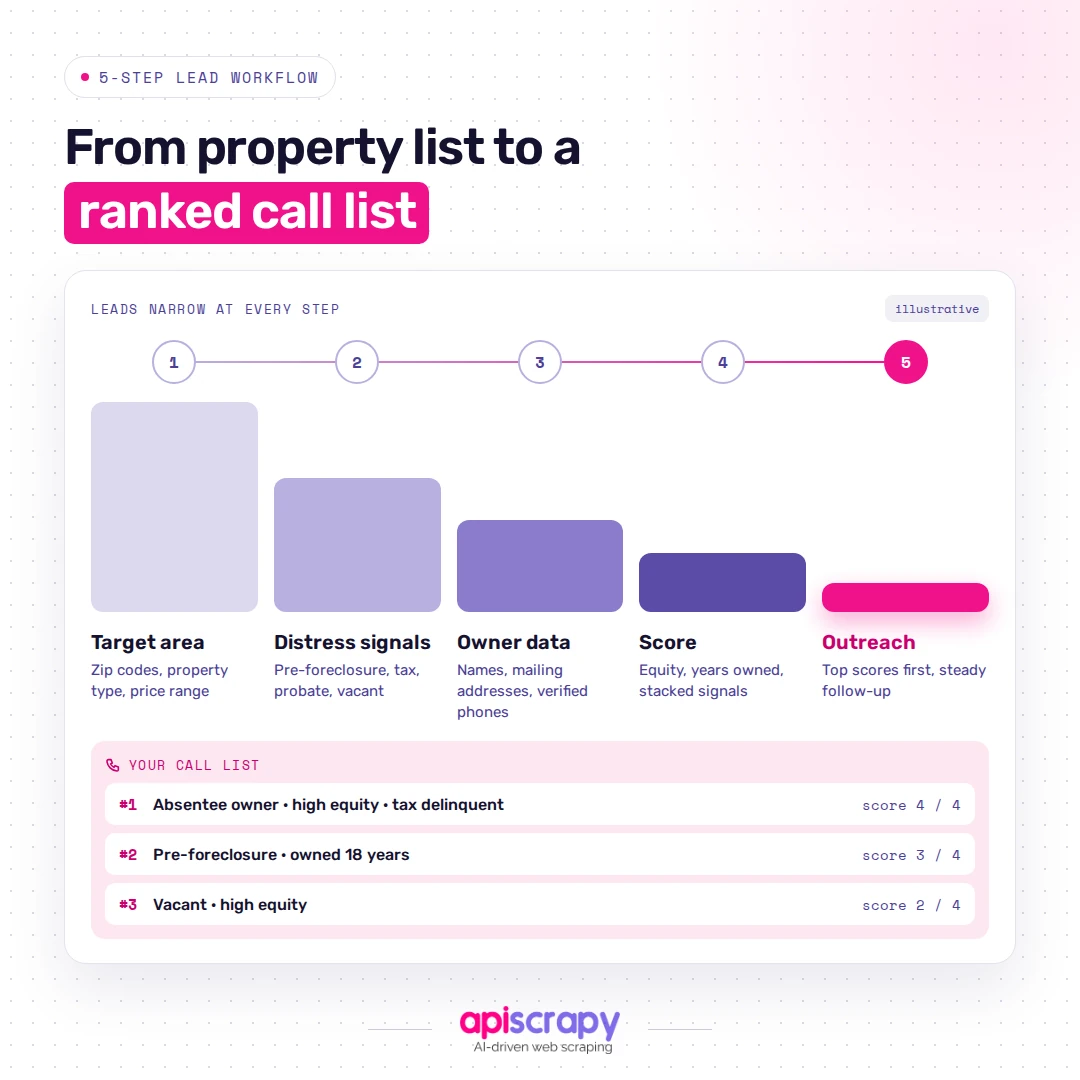
- Define your target area by zip code, property type and price range, so every search matches your buy box.
- Pull distress signals for that area: pre-foreclosure, tax delinquency, probate, vacancy and expired listings, via public records or a data extraction service.
- Enrich each record with owner names, mailing addresses and verified phone numbers through skip tracing.
- Layer in property data such as equity, comps, estimated rent and ownership history.
- Score and rank leads by equity, years owned and how many distress signals stack on one owner.
- Contact the top-scored owners first, then follow up on a fixed cadence across calls, texts and mail.
Listed homes now draw multiple offers within days, so serious investors compete on data, not luck. The best real estate investor leads sit off-market: in public records, expired listings, tax-delinquency files and other signals of seller distress.
This guide is a practical walkthrough. You will learn how to find, qualify and convert investor leads using property data, and which sources and services are worth your time.
How we evaluated each method and source:
- Data accuracy: Does the owner, address and equity information match county records?
- Freshness: How quickly do new distress signals appear in the data?
- Contact coverage: Can you actually reach the owner with a verified phone or email?
- Hands-on testing: We tested workflows with investors and wholesalers, then compared notes from customer conversations.
Disclosure: APISCRAPY is our own data extraction service and appears in this guide. We list its limits as plainly as those of every other source.
Our goal is simple: help you choose the right approach for your strategy, whichever service you end up using.
Ready to build a steady pipeline of investor leads? Book a demo with APISCRAPY and see structured property data in action.
How Web Scraping Generates Real Estate Leads
Web scraping is the automated collection of publicly available property information, which a data extraction service then cleans and structures into usable lead lists. Instead of copying records by hand, you receive rows of owners, addresses and signals ready for outreach.
Extracting Contact Information
Listings, county assessor sites and public records hold owner names, mailing addresses and sometimes phone numbers. A good service matches these records to a single owner profile, then enriches them with verified contact details. Always use the data lawfully: respect privacy rules and Do Not Call lists.
Targeting Motivated Sellers
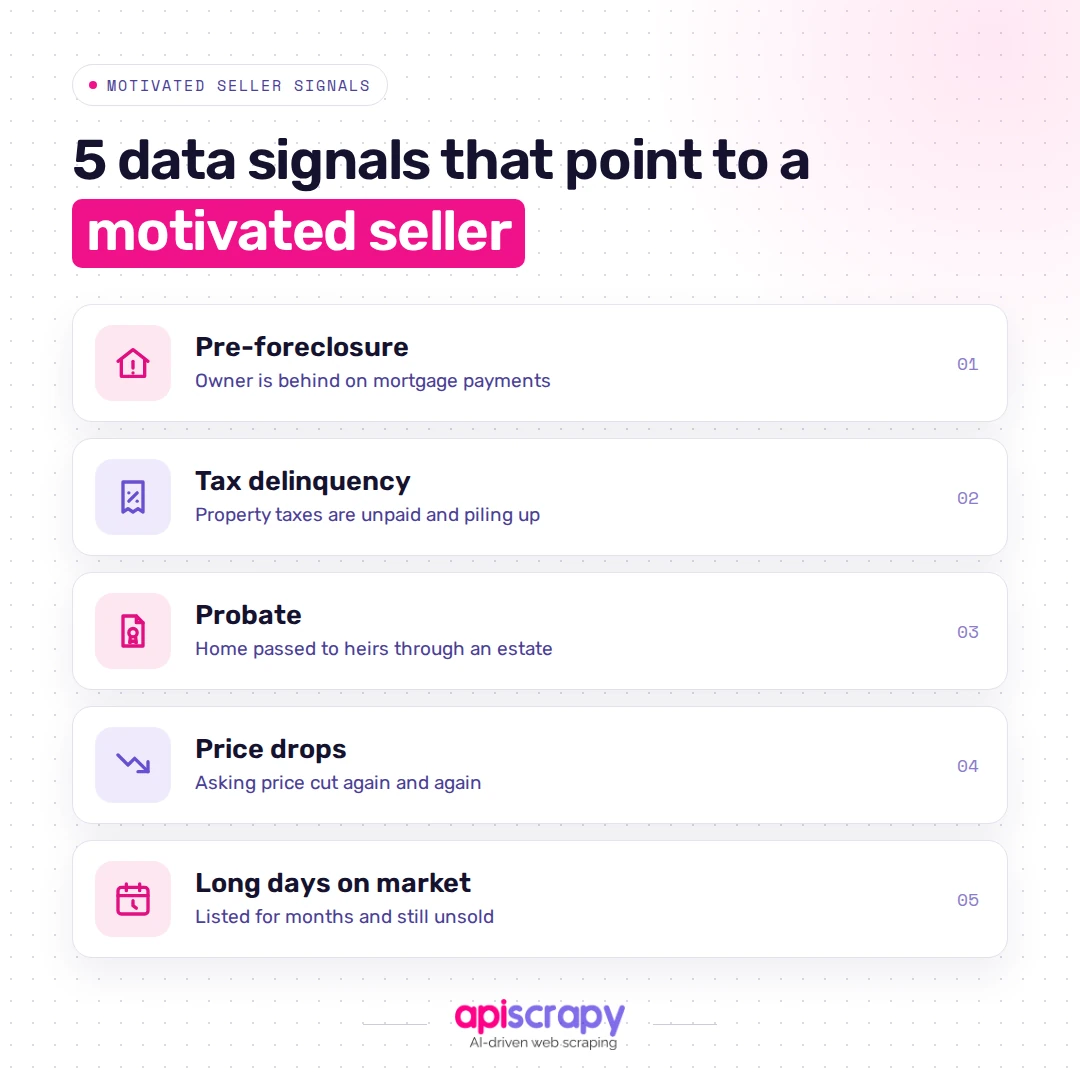
Motivated sellers leave a trail. Look for pre-foreclosure notices, tax delinquency, probate filings, repeated price drops and long days on market. Scraping surfaces these signals within days of publication, so you reach the owner before other investors do.
Property Intelligence & Analytics
Raw leads are not enough. Pair each record with comparable sales, estimated rent, ownership history and available equity. Scoring deals before outreach means you call only the owners whose numbers fit your buy box.
Bypassing Technical Barriers
Real estate sites use CAPTCHAs, rate limits, anti-bot rules and dynamic pages that break basic scripts. A managed data extraction service handles proxies, rendering and site changes for you, so your team spends time on deals instead of maintaining scrapers.
How to Find Motivated Seller Leads for Real Estate Investing
A motivated seller needs to sell quickly because of debt, inheritance, relocation or a property they can no longer maintain. They are the highest-value investor leads because price is rarely their first concern.
- Define your target area. Pick zip codes, property types and a price range that match your buy box.
- Pull distress signals. Collect pre-foreclosure, tax-delinquent, probate, vacant and expired-listing records for that area.
- Enrich with owner data. Add owner names, mailing addresses and verified phone numbers through skip tracing.
- Score and prioritize. Rank leads by equity, years owned and number of distress signals stacked together.
- Reach out consistently. Start with the top-scored owners and follow up across calls, texts and mail.
Fresh, structured property data speeds up every step, because you stop cleaning spreadsheets and start talking to owners.
How Long Does It Take to Convert a Real Estate Lead Into a Deal?
Most investor leads take roughly one to six months to become a signed deal, though hot motivated sellers can close in a few weeks.
The timeline depends on lead source, seller motivation, financing and property condition. A probate lead with a clear heir moves differently from a landlord weighing a sale.
Speed to lead matters most. Calling a fresh lead within minutes, ranking owners by data and following up on a fixed cadence shortens the cycle noticeably.
Timelines also vary by market and strategy, so expect flips, rentals and wholesale deals to run on different clocks.
Do You Need a Real Estate Agent to Find Investment Properties?
No, but whether you need one depends on your strategy and experience.
An agent adds real value through MLS access, negotiation skill and local market knowledge, especially for first-time buyers or out-of-state investors.
Property data and lead lists let you find off-market deals on your own, because you can see ownership, equity and distress signals before a property is ever listed.
The smartest setup is a hybrid: use data to source deals, and bring in professionals for contracts, inspections and closing.
Find the Right Investment Property Faster
Filtering a large dataset beats scrolling listings by hand, because you narrow thousands of properties to the few that match your numbers. Start with these filters:
- Location and price: Limit results to zip codes and price bands you know well.
- Equity and ownership length: Owners with high equity and long tenure can accept a discount and still profit.
- Rental yield: Compare estimated rent to price, using a screen such as the 7% rule (annual gross rent of at least 7% of price).
- Distress indicators: Add liens, delinquent taxes, vacancy or code violations to surface motivated sellers.
Tighter filters mean fewer wasted calls, which means offers go out sooner.
What Are the Best Sources for Real Estate Investor Leads in 2027?
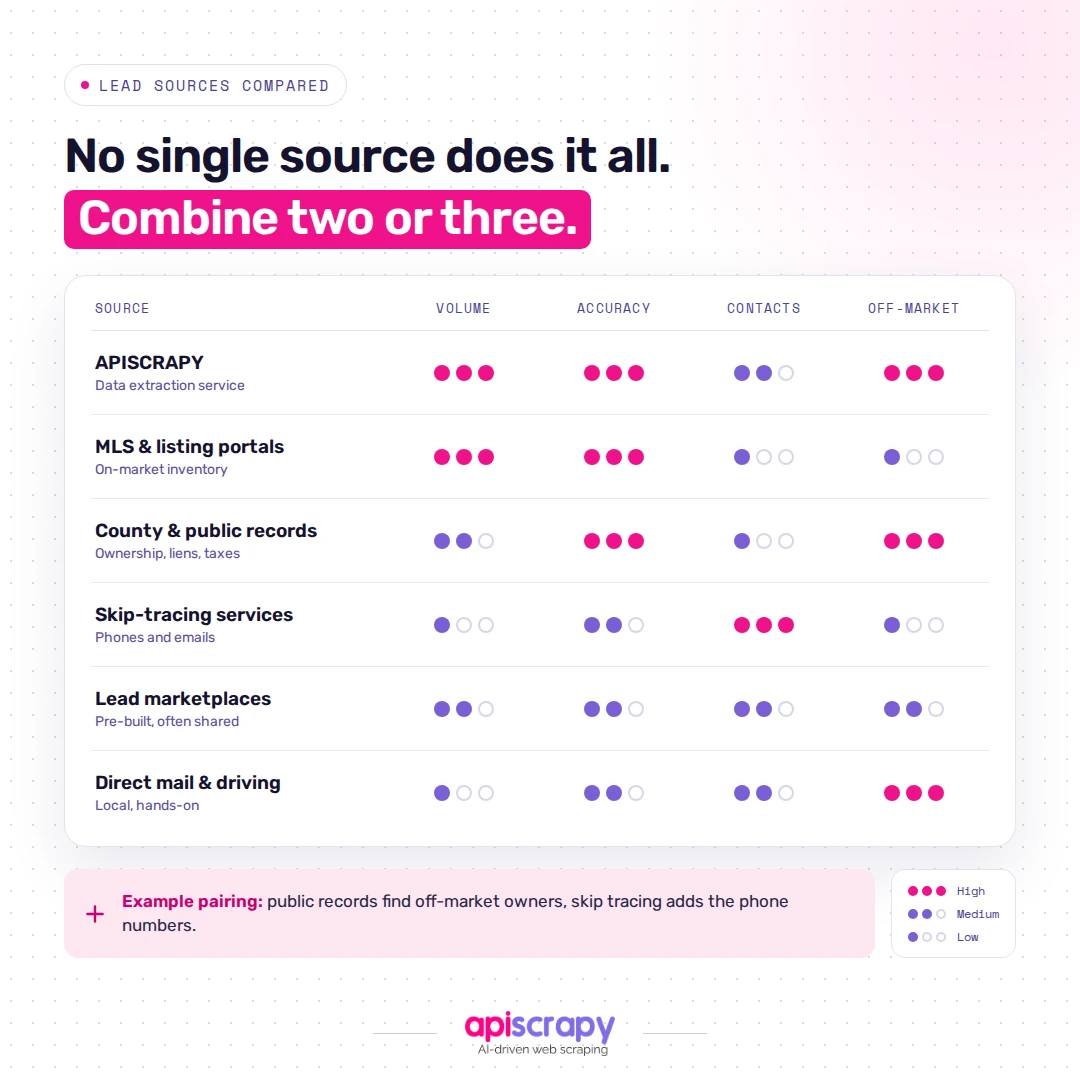
The best sources combine volume, accuracy and contact coverage. Here is how the main options compare, each with its best use and one limitation:
- APISCRAPY: A data extraction service that delivers structured, fresh property and owner data at scale. Best for investors who want custom lists; it needs a short onboarding to define your fields.
- MLS and listing portals: Reliable for on-market inventory and comps. Owners are already listed, so competition is highest and off-market signals are limited.
- County and public records: The most trusted source for ownership, liens and tax status. Formats differ by county, so manual collection is slow.
- Skip-tracing services: Best for finding phone numbers and emails once you have an owner name. They add contacts but do not find the leads themselves.
- Lead marketplaces: Quick to start and good for testing a market. Leads are often shared with other buyers, which lowers response rates.
- Direct mail and driving for dollars: Low-tech and effective for local niches. Both are hard to scale across many markets.
Most investors do best by combining two or three of these sources, so one fills the gaps the others leave.
Best Ways Real Estate Data Extraction Can Help You
Automated real estate data extraction replaces hours of manual research with a steady, structured feed of property information. The practical benefits are:
- Saves research time: Hours spent copying records from county sites and portals shrink to minutes.
- Scales lead volume: Pull thousands of records across several counties without adding staff.
- Improves lead quality: Stack signals such as equity, tax delinquency and vacancy to rank the best owners first.
- Tracks market changes in real time: Get alerts on new listings, price drops and fresh filings the day they appear.
- Cuts errors and cost: Consistent formats reduce typos and duplicate records, which also lowers wasted outreach spend.
Better data leads to better deal decisions, and better decisions are what protect your margin.
How to Generate Real Estate Leads Faster with APISCRAPY
APISCRAPY suits investors, wholesalers, brokerages and proptech teams that need property and owner data in volume, not one record at a time.
Its strength is structured, regularly refreshed property and contact data, delivered through managed extraction so you never maintain scrapers yourself.
It clearly outperforms manual research and static list vendors on freshness and customization: you choose the fields, areas and signals, rather than buying a generic list.
It fits teams that already have a repeatable outreach process and want to feed it faster, from solo investors to multi-market operators.
Once you receive a data file, scoring leads takes a few lines of code. This example ranks owners by equity and distress signals:
import pandas as pd

leads = pd.read_csv("property_leads.csv")

# Simple lead score: equity, long ownership and stacked distress signals

leads["score"] = (

(leads["equity_pct"] >= 40).astype(int)

+ (leads["years_owned"] >= 10).astype(int)

+ leads["tax_delinquent"].astype(int)

+ leads["pre_foreclosure"].astype(int)

)

top_leads = leads.sort_values("score", ascending=False).head(100)

top_leads.to_csv("call_list.csv", index=False)
Example scenario (replace with a real client result before publishing). A two-person wholesaling team spent about 15 hours a week copying county records and still missed new pre-foreclosure filings.
After switching to automated extraction, they received a ranked list each Monday and spent that time on calls. Outreach started days earlier and they reached more owners per week.
Ready to build a steady pipeline of investor leads? Book a demo with APISCRAPY and see structured property data in action.
Start Building Your Web Crawler Today
Conclusion
Data-driven sourcing beats guesswork. Investors who rely on property data, public records and structured lead lists find off-market deals earlier and waste fewer calls.
The key takeaway is to focus on motivated sellers and move fast: fresh signals, scored leads and consistent follow-up shorten the path to a signed deal.
If you want a ready pipeline of investor leads, Book a Demo with APISCRAPY and see how structured property data can fill your next deal cycle.
Frequently Asked Questions About Real Estate Investor Leads
What is the 7% rule in real estate?
It is a quick screen: a rental's annual gross rent should equal at least 7% of its purchase price. Some investors instead mean a 7% total return, so confirm which definition is meant.
What is the best platform to generate leads for real estate?
There is no single best option. Data extraction services like APISCRAPY suit off-market investor lists, while listing portals suit agents chasing buyers.
How can I get leads for real estate?
Combine public records, distress signals, skip tracing, direct mail and referrals, then rank owners by equity before you reach out.
How much do realtor leads cost?
Commonly reported prices run about $25 to $100 per lead, and portal subscriptions often start near $200 a month for shared leads. Exclusive leads cost more.
Is buying real estate leads worth it?
It can be, if you follow up within minutes and track cost per closed deal rather than cost per lead.
FAQ schema for your page (paste into the page head inside a script tag of type application/ld+json):