AI Web Data Extraction vs Traditional Scraping: Which One Fits Your Project?
TL;DR
Your scraper worked flawlessly for weeks until a website redesign disrupted your entire pipeline. AI Web Data Extraction can help adapt to changing layouts, but AI is not always the answer. The real solution lies in choosing the right extraction method for your data sources, project scale, accuracy requirements, and maintenance budget.
- Stable, simple sources: Stick with traditional scraping. It is fast, cheap to build, easy to audit, and near 100% accurate while the HTML holds.
- Dynamic or fast-changing sites: Use AI extraction. It reads page meaning instead of fixed selectors, so it keeps working after redesigns and handles JavaScript natively.
- Cost reality: Rule-based scrapers can eat about 30% of engineering time across 10+ sites. Beyond 15 to 20 sources, AI usually wins on total cost within 6 to 12 months.
- Watch the trade-offs: AI can occasionally return values not on the page, so add validation. Neither method guarantees a bot-detection bypass.
- Stay compliant: Extraction method does not set your legal risk. What you collect does, especially personal data under GDPR, CCPA, or India’s DPDP Act.
- Best of both: Most enterprise teams run a hybrid, with traditional scrapers on stable sources and AI on the rest. APISCRAPY builds and manages that setup for you.
Most web scraping projects start the same way. Someone needs data, a developer writes a script, and it runs fine for a few weeks. Then a site updates its layout and half the pipeline breaks.
If you have managed scrapers in production, that story probably feels familiar. In 2026, more teams are turning to AI-powered extraction to fix it, but it is not the right call for every project. According to production data tracked by APISCRAPY, teams maintaining rule-based scrapers across 10 or more websites spend about 30% of their engineering time just keeping those scrapers alive.
This guide compares both approaches honestly. You will see how each one works, how they stack up on cost, accuracy, and maintenance, and which one fits your situation. If a hybrid setup makes sense for you, there is a section on that too.
What Does Traditional Scraping Actually Do, and Where Does It Break?
Traditional scraping is built on structure. A scraper reads a page’s HTML, navigates the DOM with CSS selectors or XPath, finds the elements that hold your data, and pulls them out. Libraries like BeautifulSoup and Scrapy do most of the heavy lifting in Python workflows.
When a page needs interaction, such as dropdown menus or JavaScript-rendered content, Selenium or Playwright simulates a real browser session. On consistent sites, this approach is fast, cheap to build, and easy to debug. Because the logic is explicit, it is also easy to audit, which matters in regulated environments.
How Does a Rule-Based Scraper Read a Page?
Say your scraper finds a product price by targeting div.product-price span.amount. It works perfectly until a developer renames the class to price-wrapper or moves the price into a different element. At that point the scraper returns nothing or, worse, the wrong value with no warning.
That is what engineers mean when they call a scraper fragile. It does not understand what a price is. It only knows where the price was on the day the script was written, so even minor redesigns, A/B tests, or CMS template updates can break it.
When Is Traditional Scraping Still the Smart Choice?
Despite its fragility on dynamic sites, traditional scraping is still the right tool in several situations. At APISCRAPY, we recommend it for:
- Government or regulatory databases with stable, long-term HTML structures
- Internal data feeds where you control the source system
- Academic repositories and research portals with standard HTML
- Small projects with a handful of sources and low update frequency
- Budget-limited projects where LLM API costs are hard to justify
Traditional scraping has not become obsolete. It has found its natural home in smaller, more predictable data projects where maintenance stays manageable.
How Does AI Data Extraction Work Differently?
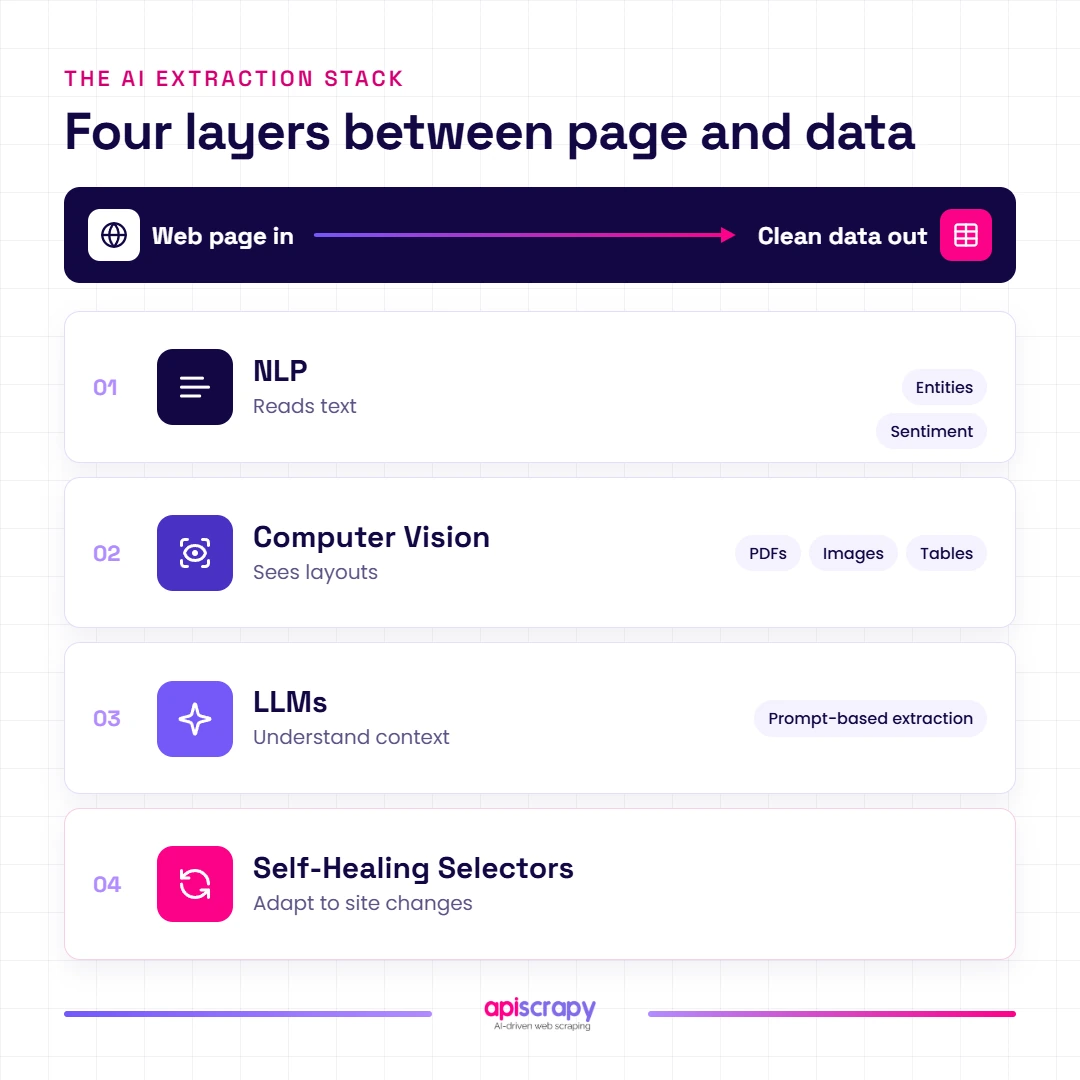
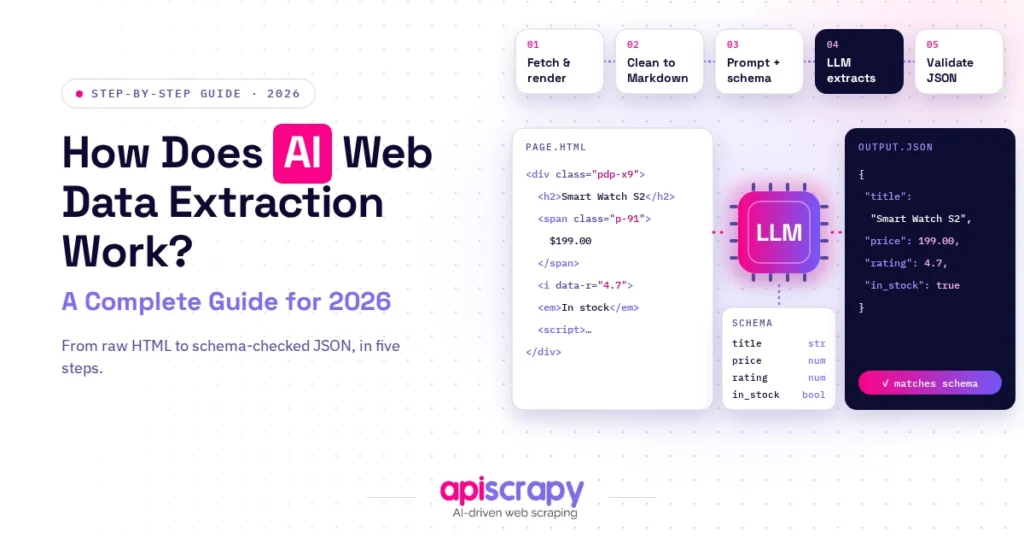
AI-based extraction does not depend on a specific HTML structure. It uses language models and natural language processing to understand what the content means, then extracts the data you asked for. In other words, it reads the page more like a person would.
Think of it this way. A traditional scraper is told to find the third line under the Ingredients heading on a recipe card. An AI extractor is shown the dish and asked to list the ingredients, whether they appear on a card, a web page, or a photo.
What Changes When a Scraper Understands Context?
You give an AI extractor plain-language instructions, such as: find the job title, company name, salary range, and posting date. It applies them to whatever HTML or rendered text it receives and works out the layout fresh each time.
A traditional scraper might target span.listing-salary on a job board. An AI extractor finds the salary whether it sits in a table, a badge, a paragraph, or a tooltip, and whether it appears as a number, a range, or a phrase like “competitive salary”. It can also flag ambiguous cases for review.
Prompt-based setup also means non-technical users can define what they need without writing code. That lowers the cost of building and updating data pipelines.
Why Does AI Extraction Keep Running After a Site Redesign?
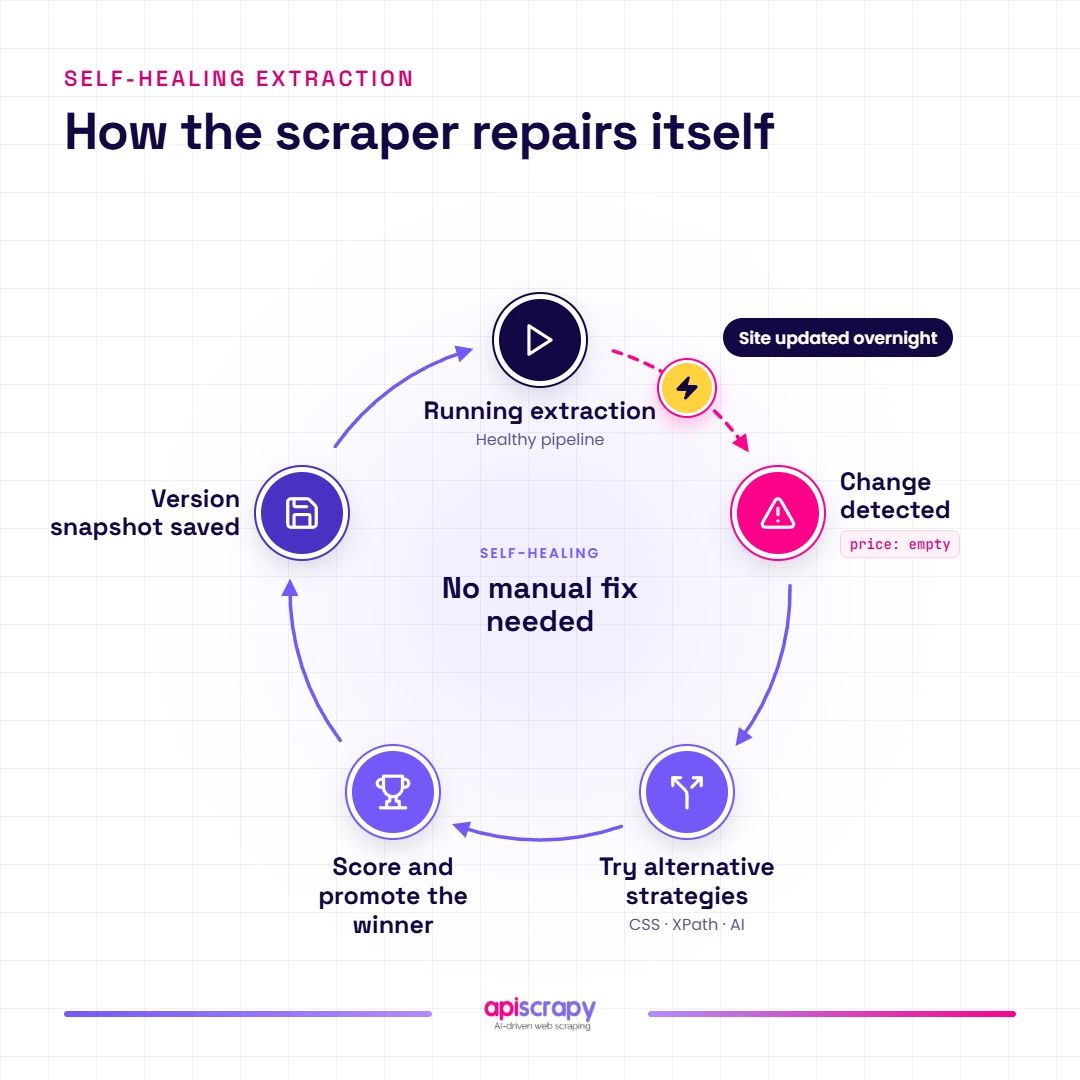
When a site changes its layout, a traditional scraper waits for a developer to fix its selectors. An AI-powered pipeline detects the change, adapts to the new page, and keeps extracting. This is often called self-healing extraction.
Teams that switched from traditional to AI-based extraction have reported maintenance reductions of 60 to 80 percent, especially across many diverse sources. APISCRAPY has seen the same pattern across retail, travel, and financial data projects.
Is All AI Scraping the Same?
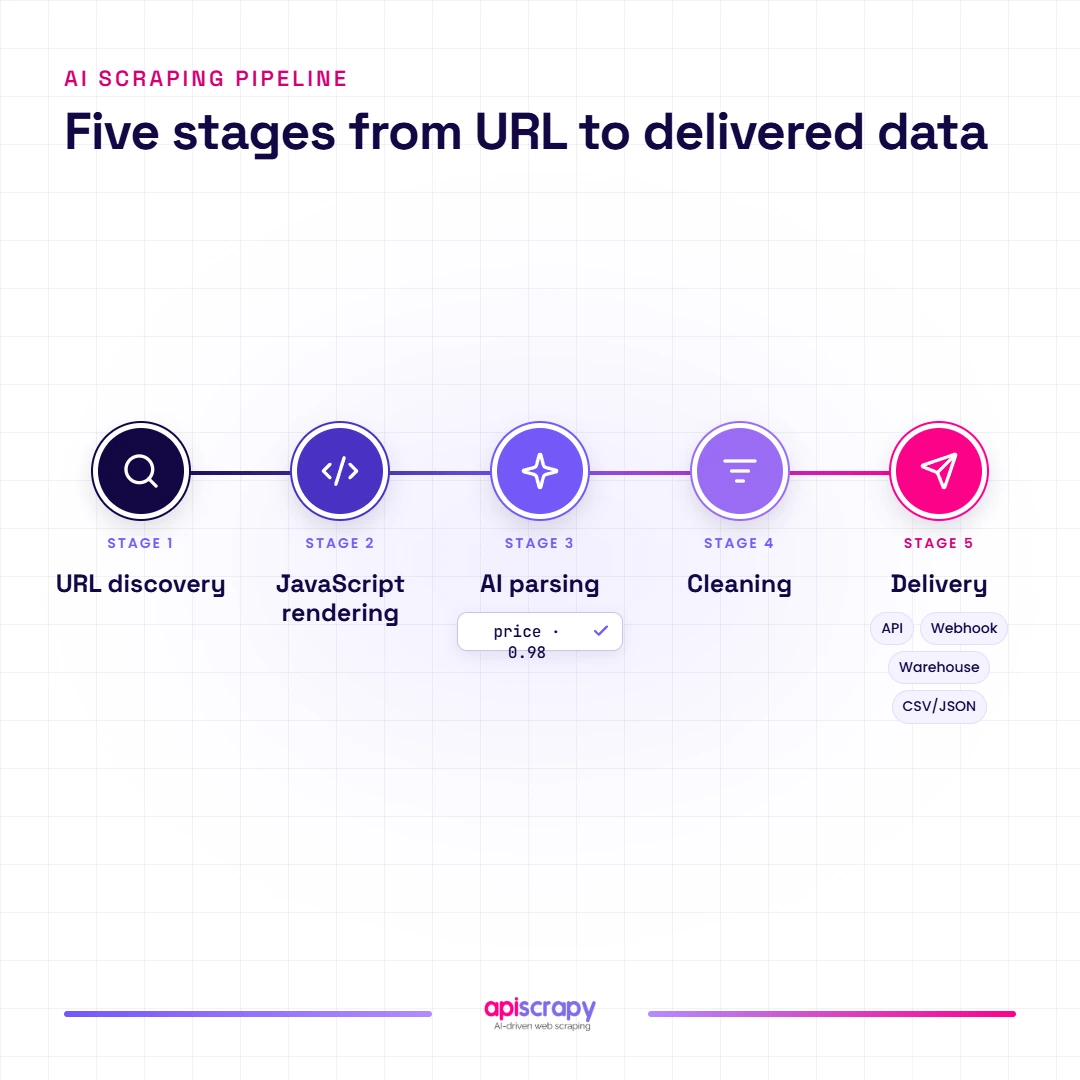
Not quite. “AI scraping” usually means one of three methods, and each has its own cost, speed, and accuracy profile.
- AI-generated code: a model writes the selectors or parser once, then ordinary code runs it at scale.
- Full-page LLM extraction: a model reads each page and returns the fields you asked for.
- Vision-based extraction: a model reads a screenshot of the page instead of the HTML.
Knowing which one a vendor actually uses helps you judge their cost and accuracy claims.
How Do the Two Methods Compare on Speed, Accuracy, and Cost?
This is where most decisions get made. The figures below reflect production data from APISCRAPY projects and published research on LLM-based extraction. Context matters, so a number that looks great in one project may be irrelevant in another.
| Factor | Traditional Scraping | AI-Based Extraction | Hybrid Approach |
| Setup time | Low (hours) | Medium (days) | Medium |
| Maintenance | High (breaks often) | Low (self-healing) | Low to medium |
| Accuracy (static sites) | Near 100% | 99%+ | Near 100% |
| Accuracy (dynamic sites) | 60 to 80% | 99.5%+ | 99%+ |
| JavaScript-heavy sites | Needs Selenium or Playwright | Handles natively | Best of both |
| Cost over 12 months | Developer time heavy | LLM API fees, lower dev time | Optimised |
| Scale (50+ sites) | Breaks frequently | Adapts automatically | Recommended |
| Best for | Static, predictable sources | Complex, varied sources | Enterprise scale |
When Does 99.5% Accuracy Matter, and When Doesn’t It?
On static, well-structured sites, a maintained traditional scraper can reach close to 100% accuracy. AI extraction on complex, dynamic pages typically reaches about 99.5%. The gap looks small, but it grows with volume.
Across 10 million records, a 0.5% error rate means 50,000 wrong values. That is a real problem for financial data or legal records. For e-commerce price monitoring, it may be perfectly acceptable.
What Does Scraping Really Cost Over 12 Months?
A traditional scraper is cheap to start. A developer can build one for a single site in a day or two. The cost shows up later.
- Projects monitoring 50 or more websites with traditional scrapers have been documented to need over 100 developer-days a year in maintenance alone.
- AI pipelines cost more upfront and add ongoing LLM API fees, but they cut maintenance sharply.
- For most projects beyond 15 to 20 sources, AI-based extraction tends to win on total cost of ownership within six to twelve months.
Is AI Really 30 to 40 Percent Faster on JavaScript-Heavy Pages?
Some vendors claim so, but it needs context. On simple static pages, traditional scrapers are faster because they skip LLM inference entirely. AI’s edge shows up on dynamic pages, where traditional scrapers need full browser rendering through Selenium or Playwright.
So speed is roughly equal on static content, and AI has a real advantage on complex dynamic content.
Can AI Extraction Make Up Data?
Yes, language models can occasionally return values that are not on the page. That is why production pipelines add validation rules, schema checks, and human review for high-stakes fields. Traditional scrapers do not hallucinate, but they can fail silently when a page changes.
Which Method Handles Dynamic Sites and Bot Detection Better?
This is the most common pain point in production scraping. The modern web leans heavily on JavaScript. Product listings load through AJAX, prices update live, and infinite scroll replaces pagination.
Why Does JavaScript-Rendered Content Break Most Traditional Scrapers?
When a basic scraper requests a product page, it often gets only a loading spinner and JavaScript bundles. The real product data arrives in API responses after those scripts run. Without a real browser, the scraper misses everything.
Adding Selenium or Playwright fixes that, but it brings extra infrastructure, slower extraction, and maintenance of its own.
Can AI Tools Beat CAPTCHAs and Bot Detection?
Modern bot detection fingerprints browser behaviour, including mouse movement, keystroke timing, scroll speed, and automation flags. Basic headless browsers are fairly easy to spot. Production-grade AI tools add human-like interaction, proxy rotation, and fingerprint awareness.
Still, no tool guarantees a bypass on every site. Aggressive protection like Cloudflare Enterprise or Akamai Bot Manager needs specialised handling whatever the extraction method. APISCRAPY checks each source’s bot protection level during project scoping, so there are no surprises later.
Is Web Scraping Legal? What to Check Before You Start
Legal compliance is often missing from technical comparisons, yet it matters. What counts is the type of data, how you collect it, where the data subjects live, and what the site’s terms of service say. This is general information, not legal advice.
Where Is the Line Between Public Data and Personal Data?
Data visible to any visitor without a login generally sits in a more permissive space. In hiQ v. LinkedIn, the court found that scraping public data is unlikely to violate the US Computer Fraud and Abuse Act. That does not cover data behind login walls, and it does not settle terms-of-service claims.
Things change when scraped data includes personal information covered by GDPR or CCPA. Even visible data triggers obligations once you store it in a way that identifies individuals. For EU residents, data minimisation, purpose limitation, and storage limits apply.
If you handle data about people in India, the Digital Personal Data Protection Act, 2023 adds consent and processing obligations.
Does AI Scraping Create More Legal Risk Than Traditional Scraping?
No. The extraction method does not decide your exposure. What you collect, where it comes from, and how you use it does.
AI pipelines can be built compliance-first, with filters that discard personal data, audit logs, and consent-aware rules. Traditional scrapers can include these too, but only if someone builds them deliberately. A naive scraper collects everything it finds, which can create compliance problems before anyone notices.
What Do Real Projects Look Like? Three Examples
How Did One Retail Team Handle Pricing Across 50+ Sites?
A retail analytics team began with traditional scrapers on five competitor sites, and maintenance was light. When they scaled to 55 sources across different regions and site architectures, selectors broke several times a week as promotional layouts changed.
After moving the dynamic-layout sources to an AI-based pipeline managed by APISCRAPY, maintenance incidents dropped by 71%. Data freshness for priority sources improved from daily to near real time.
What Happened When Travel Site Layouts Changed Overnight?
A travel data aggregator collected pricing and availability from 30 booking sites using traditional scrapers. Three sites redesigned their search results in the same week of peak season, breaking those scrapers exactly when the data mattered most.
Moving those three sources to AI extraction fixed the problem in hours instead of the days a selector rewrite would have taken. The other 27 stable sources kept running on traditional scrapers, unchanged.
When Was Traditional Scraping Still the Right Call?
A government contract needed data from three federal databases whose HTML had stayed consistent for over four years. The data had no personal information, updated weekly, and the budget was fixed. A well-maintained Scrapy spider did the job reliably, while AI extraction would only have added LLM costs and complexity.
That is a lesson APISCRAPY repeats to every client. The newest technology is not always the right one, so match the tool to the requirement.
How Do You Choose? Five Questions to Ask First
After working on data extraction projects across industries, the APISCRAPY team boiled the decision down to five questions. Run through them before you commit to an architecture.
- Is the target site static HTML or JavaScript-rendered? JavaScript-heavy sites give AI a clear advantage.
- How many sites are you scraping? At 15 or more, AI or a hybrid setup pays off faster.
- How often do those sites change their layouts? Frequent changes favour AI.
- What is your 12-month maintenance budget in developer hours? A small budget favours AI on total cost.
- Does the data include personal information under GDPR or CCPA? If yes, you need a compliance-aware pipeline.
When Does Running Both Methods Make More Sense?
Most enterprise-scale projects at APISCRAPY end up hybrid. Rule-based scrapers handle sources with stable HTML, where they are accurate and cheap. AI extraction handles the dynamic, varied, or fast-changing sources where maintenance would otherwise dominate.
The two layers run in parallel, each on the sources it suits best. That is not a compromise. For large multi-source projects, it is often the most cost-efficient and reliable setup.
Start Building Your Web Crawler Today
Ready to Build a Smarter Data Pipeline With APISCRAPY?
Whether you are planning your first scraping project or rethinking a pipeline that costs too much to maintain, APISCRAPY can help you design an extraction setup that fits the real problem. We run the numbers for your sources, scale, and compliance needs, then recommend what actually fits.
Book a demo with APISCRAPY to talk through your project with our data team.
Frequently Asked Questions About AI Web Data Extraction
Can AI scraping completely replace traditional methods?
Not entirely. Traditional scrapers still win on stable, simple sources, so most mature teams use both.
Is AI scraping more accurate than traditional scraping?
On dynamic, varied pages, yes (about 99.5% versus 60 to 80%). On static sites, a maintained traditional scraper is just as accurate.
Do I need to know how to code to use an AI scraper?
No, you describe the data you want in plain language. Large production setups still benefit from technical oversight.
How much does AI data extraction cost per page?
LLM inference typically adds about 0.1 to 1 cent per page. It often turns cost-positive above 100,000 pages a month across varied sources.
Which method is better for feeding data into an LLM pipeline?
AI extraction, because it outputs clean, structured data instead of raw HTML, which improves quality and cuts token use.
Which method is better for JavaScript-heavy websites?
AI extraction, since it handles dynamic content without separate browser infrastructure.
Does scraping break any privacy laws?
Public, non-personal data is generally fine in most places. Personal data of EU or Indian residents needs legal review under GDPR or the DPDP Act.