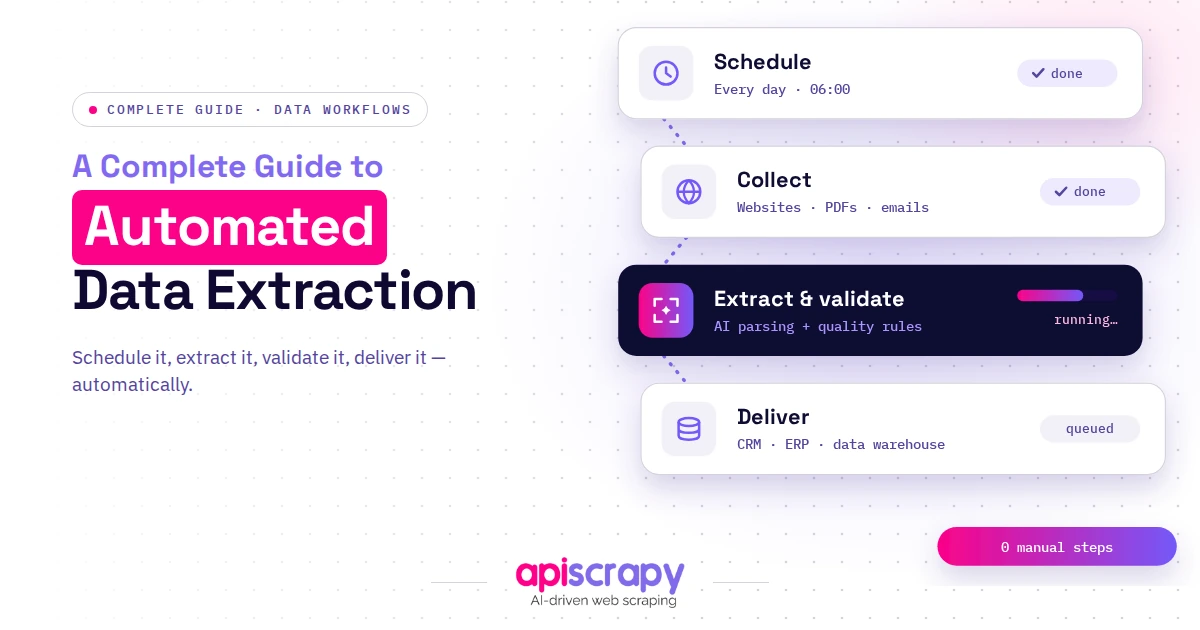
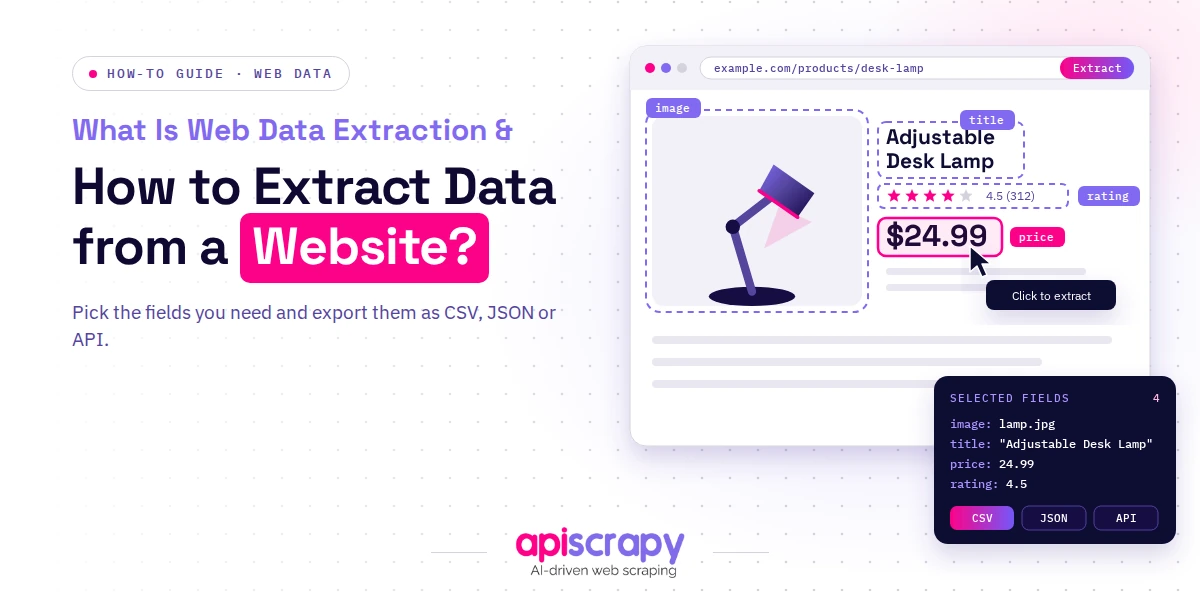
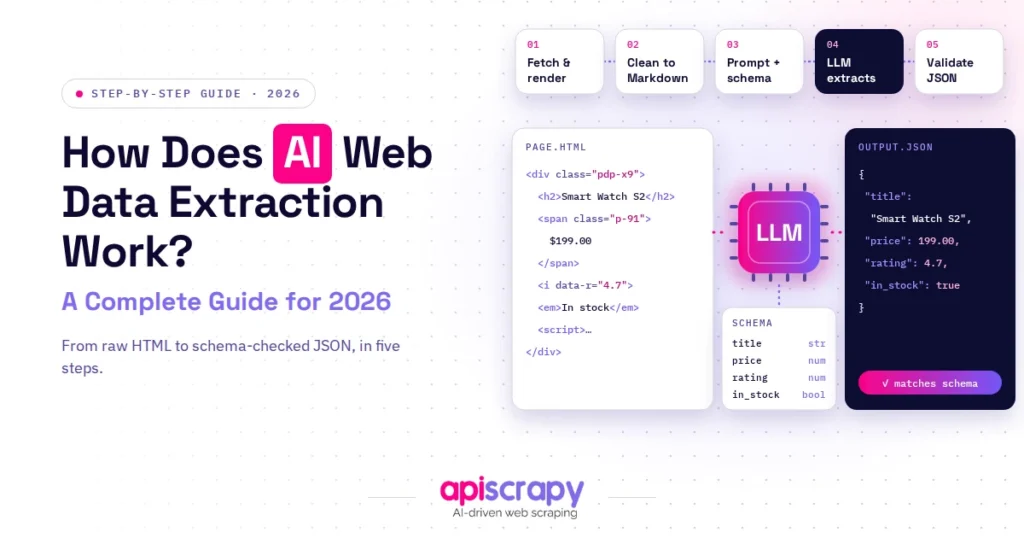
How Does AI Web Data Extraction Work? A Complete Guide for 2026
TL;DR
- Your competitor reprices products 12 times a day while your scraper struggles with every website redesign. AI Web Data Extraction Work helps bridge that gap by identifying data through meaning rather than fragile selectors, transforming messy web content into clean, structured insights delivered when you need them.
- How it works: A crawler finds pages, a headless browser renders JavaScript, an AI model maps fields to your schema, then the data is cleaned and delivered by API, webhook, warehouse, or file.
- What powers it: NLP for unstructured text, computer vision for PDFs and images, LLMs for ambiguous fields, and self-healing selectors that recover from site changes.
- Why teams switch: It handles dynamic pages natively and cuts constant manual patching. Research like the AXE paper shows pruning can cut LLM input tokens by 97.9%.
- Stay compliant: Public data is generally legal to scrape, but review robots.txt and Terms of Service, avoid login-walled content, and strip personal data under GDPR.
- Choose well: Test accuracy on your own sites, check self-healing speed and scalability, and count maintenance when comparing in-house builds with a managed service like APISCRAPY.
Imagine your competitor updates its prices 12 times a day. Its product pages refresh every few hours with flash deals, inventory shifts, and regional discounts. If you are still running a weekend manual check or a brittle scraper from two years ago, you are already losing ground.
Thousands of businesses face this right now, and many are turning to AI web data extraction to fix it. Unlike traditional scraping, which relies on fragile CSS selectors, AI systems understand context, adapt to layout changes, and make sense of unstructured content the way a trained analyst would, only far faster.
In this guide, you will learn:
- What AI web data extraction is and how it differs from traditional scraping
- The four core AI technologies behind modern extraction pipelines in 2026
- How a real extraction pipeline works, step by step
- Where the technology delivers measurable business value
- How to stay legal and ethical, and how to choose the right tool
What Is AI Web Data Extraction, and How Is It Different From Traditional Scraping?
Web scraping in its original form meant writing rules. A developer inspected a page, found the CSS class or XPath of the element they needed, and hardcoded instructions to grab it. That works for stable pages, but the web has never been stable, and it changes faster every year.
AI extraction flips the approach. Instead of telling the system exactly where to look, you describe what you want and the system works out where to find it. Trained models recognise patterns across thousands of page structures, so they do not fall apart when a developer renames a div class.
Why Do Traditional Scrapers Keep Breaking?
Rule-based scrapers are brittle by design. These are the failures teams hit most often:
- Site redesigns: even a small layout change can leave XPaths and CSS selectors pointing at nothing or returning wrong data.
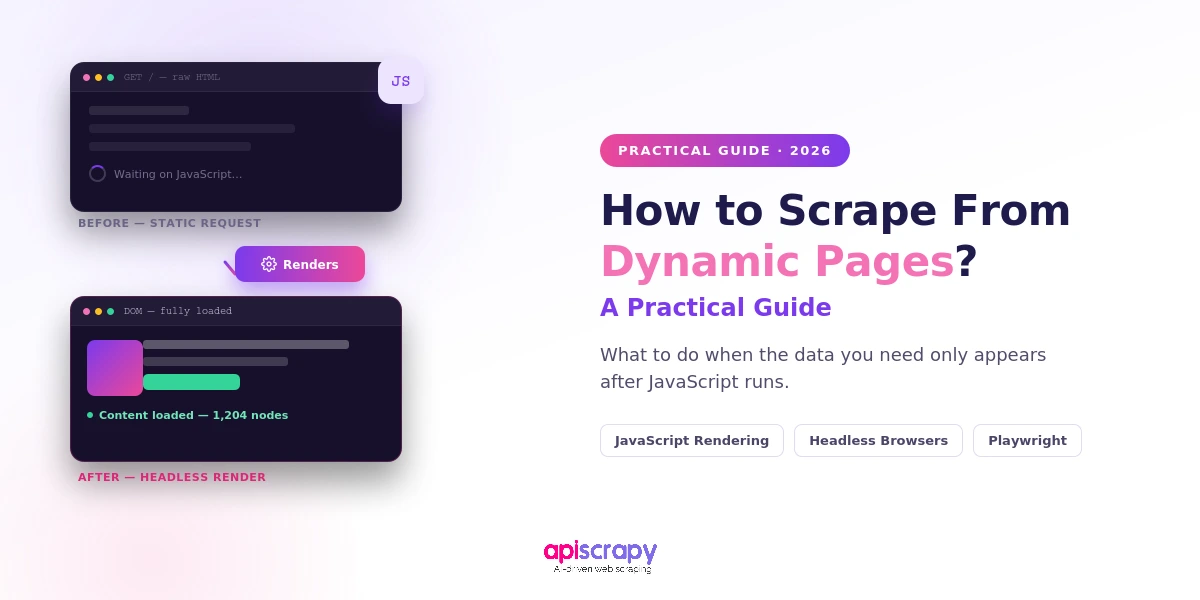
- JavaScript rendering: React, Angular, and Vue load content dynamically, so a basic HTTP request returns an empty shell.
- Constant maintenance: every site update needs a human patch, which becomes a full-time job across hundreds of domains.
- Scale limits: writing and maintaining rules for thousands of URLs does not work at enterprise scale.
How Does AI Overcome Those Limits?
AI systems learn what a price looks like, not just where it sits on one page. They use context, surrounding text, and layout signals to find fields wherever they appear in the DOM. The main advantages are:
- Pattern learning: models trained across millions of pages recognise data by meaning, not by HTML address.
- Self-healing selectors: when an extraction path stops working, the system detects the anomaly and looks for the element in its new location.
- Generalisation to new sites: research shows language models can extract from pages they have not seen before, although accuracy varies by page type and model.
- JavaScript handling: headless browsers render dynamic content fully before parsing, so React and Angular pages are treated like static HTML.
Traditional Scraping vs AI Extraction: How Do They Compare?
| Criteria | Traditional Scraping | AI-Powered Extraction |
|---|---|---|
| Selector type | CSS / XPath rules | ML-based pattern detection |
| When a site changes | Breaks immediately | Self-heals automatically |
| JavaScript pages | Fails without extra setup | Handles natively |
| Unstructured text | Cannot parse meaning | NLP extracts context |
| New site, no training | Requires manual re-coding | Generalises from learned patterns |
| Setup time | High (rules for each site) | Lower (learns from examples) |
| Ongoing maintenance | Constant manual patches | Minimal and automated |
| Accuracy at scale | Degrades as sites evolve | More consistent over time |
Which AI Technologies Power Web Data Extraction in 2026?
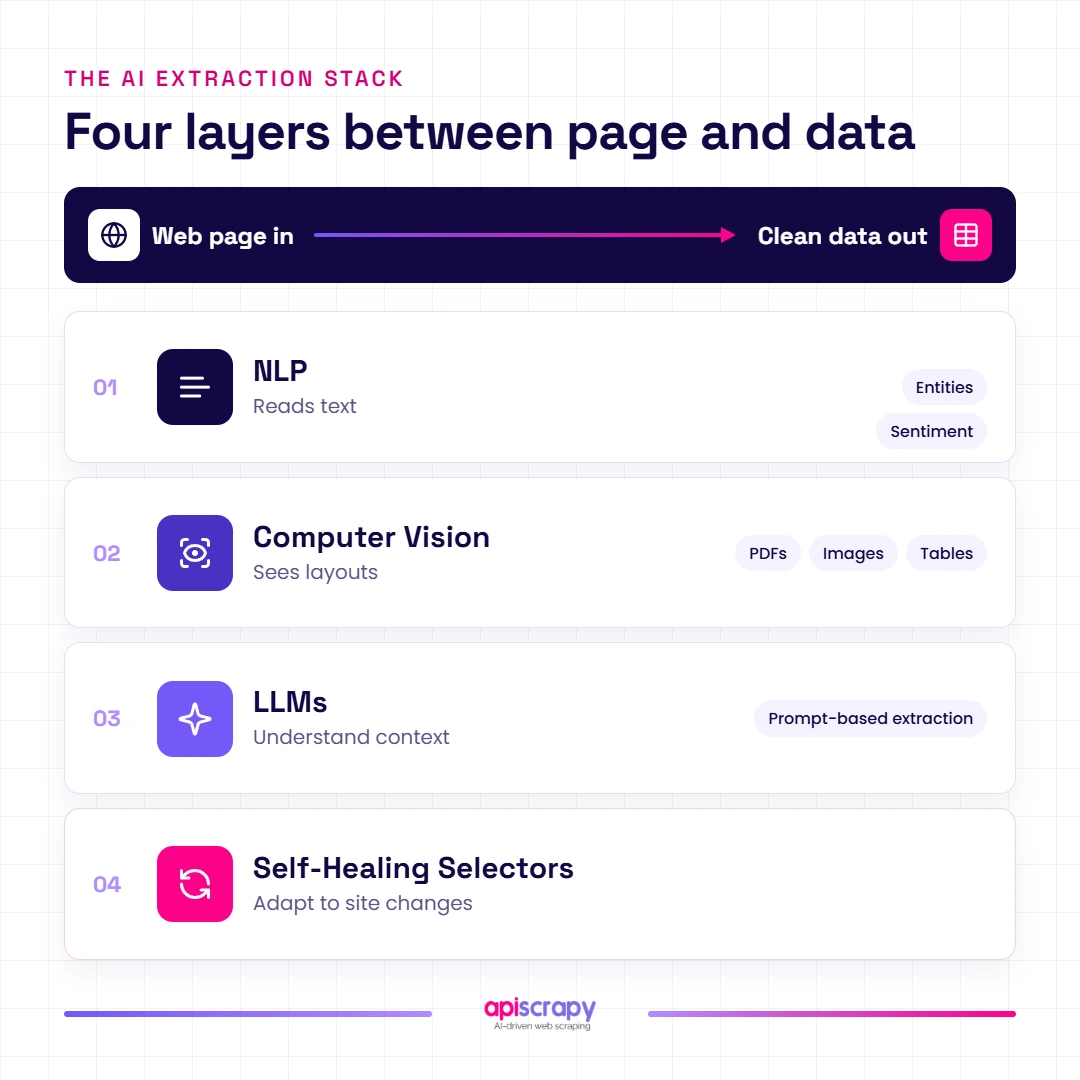
Most guides stay surface-level here, but knowing the technology stack helps you evaluate tools and set realistic expectations. Four technologies do the heavy lifting in every modern extraction pipeline.
1. How Does NLP Make Sense of Unstructured Text?
Most of the web is unstructured text, and natural language processing lets extraction systems read it meaningfully. In an extraction pipeline, NLP typically provides:
- Named Entity Recognition (NER): finds people, companies, locations, dates, and product names in raw text without field-level rules.
- Sentiment analysis: classifies reviews, news mentions, and feedback as positive, negative, or neutral.
- Topic classification: groups articles, listings, and posts by subject without predefined labels.
- Intent extraction: spots whether a block of text is a price announcement, a policy change, or a hiring signal.
When APISCRAPY extracts competitive intelligence from industry news sites for clients, NLP turns thousands of raw articles into clean, categorised datasets analysts can use immediately.
2. Why Does Computer Vision Matter for Layout Understanding?
Not everything can be understood from the DOM tree alone. Computer vision lets a system see a page the way a human sees a browser window. It is critical for:
- PDF documents: tables, invoices, and reports that are scanned or image-based rather than HTML text.
- Image-based listings: prices, SKUs, or labels that exist only inside product images.
- Complex tables: column boundaries and relationships that DOM parsing often gets wrong.
- Resistance to anti-bot traps: vision-language models that read pages visually are less affected by CSS-class randomisation than DOM-dependent approaches.
3. What Can LLMs Do That Rules Cannot?
Large language models have changed what is possible in extraction. They bring four capabilities to a pipeline:
- Prompt-based extraction: describe what you want in plain language and the model finds it, even on unfamiliar pages.
- Ambiguity resolution: when a product title and a category breadcrumb use similar wording, the model uses context to tell them apart.
- Unstructured to structured: raw paragraphs from news or earnings reports become structured fields without pre-built templates.
- Lower cost through pruning: a February 2026 research paper called AXE paired a 0.6B parameter model with DOM pruning, cutting input tokens by 97.9% on the SWDE benchmark while scoring about 88% F1.
Well-designed pipelines use LLMs selectively. They apply them to ambiguous or novel pages and route routine extractions through faster, lighter models to control cost and latency.
4. How Do Self-Healing Selectors Actually Work?
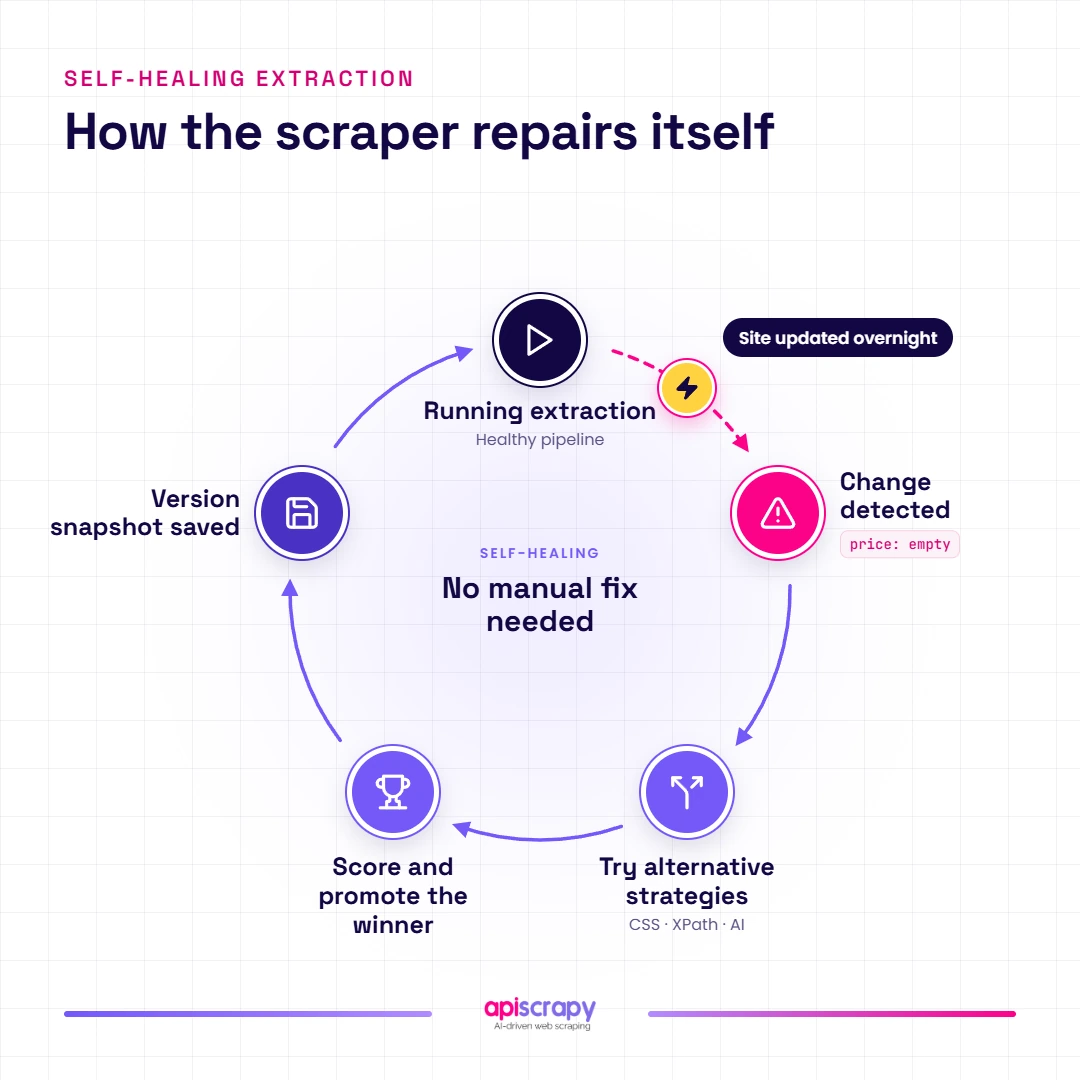
Self-healing is not a marketing term. It describes specific mechanisms that keep pipelines running through site changes:
- Change detection: extraction output is compared against expected patterns, so empty fields or format mismatches trigger alerts.
- Automated re-learning: when a field goes missing, the system tries alternative strategies and promotes the one that returns valid data.
- A/B strategy comparison: several parsing approaches run in parallel, are scored on quality, and the winner is promoted.
- Version tracking: snapshots of site structure let the system diff page versions and find where an element moved.
At APISCRAPY, adaptive parsing is a core part of managed extraction for e-commerce and financial data clients. It keeps pipelines running when target sites update overnight, without manual intervention.
What Happens Between a URL and Clean Data? A 5-Step Walkthrough
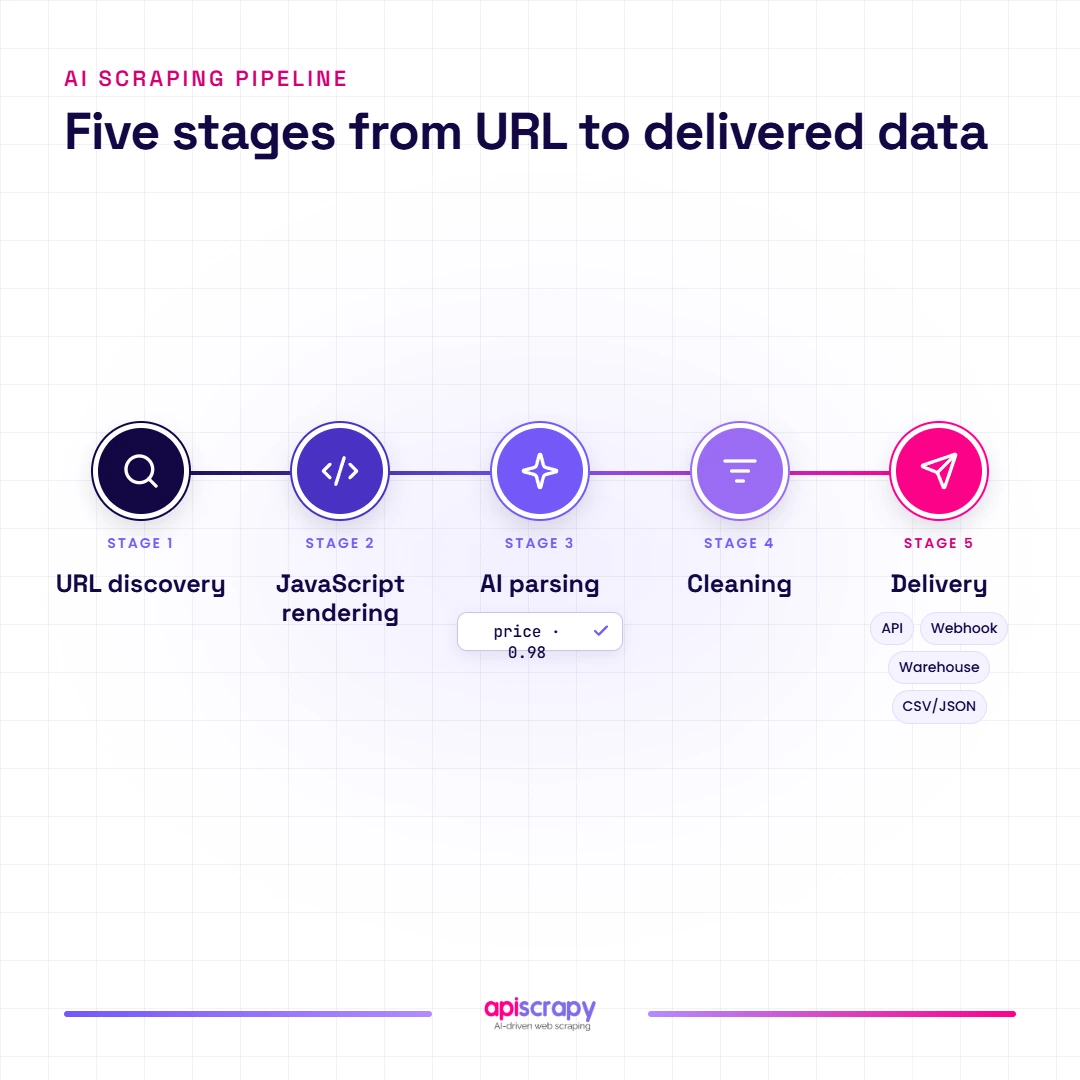
Knowing the stages of a real pipeline helps you ask better questions when you evaluate tools and spot where problems occur. Here is what happens between giving a target URL and receiving structured data.
| Step | Stage | What Happens |
|---|---|---|
| 1 | URL discovery | A crawl scheduler maps target pages and prioritises them by change frequency |
| 2 | JavaScript rendering | A headless browser loads the full page, including dynamic content |
| 3 | AI parsing | An ML model identifies fields and maps them to your data schema |
| 4 | Cleaning | Formats are normalised, junk is stripped, and near-duplicate records are removed |
| 5 | Delivery | Data is pushed to an API, webhook, or warehouse on your schedule |
Step 1: How Do Crawlers Find the Right Pages?
Everything starts with knowing where to look. A production-grade crawl layer handles:
- Sitemap parsing: reads XML sitemaps to find indexable pages without brute-force crawling.
- Link graph traversal: follows internal links to reach pages missing from sitemaps, including dynamically generated listings.
- Priority scheduling: crawls fast-changing pages such as prices and news more often than static ones.
- Rate control: throttles requests to stay polite and avoid triggering anti-bot measures.
Step 2: How Are JavaScript Pages Rendered?
Headless browsers such as Puppeteer and Playwright solve the rendering problem. The crawl layer:
- Starts a browser instance and loads the full page, including all dynamic content
- Waits for network requests to settle before passing the DOM to the parser
- Handles scroll-to-load, click-to-expand, and pagination automatically
- Manages sessions, cookies, and user-agent rotation to keep crawls continuous
Step 3: How Does the AI Find Your Fields?
With a fully rendered page in hand, the parsing layer:
- Applies trained models to match page elements to your requested fields
- Uses LLM reasoning where rule-based models are unsure
- Maps raw elements to a structured schema, such as product name, price, availability, author, and date
- Assigns a confidence score to each field so low-confidence values can be flagged for review
Step 4: How Is Raw Data Cleaned?
Raw extracted values are rarely ready for analysis. The cleaning layer takes care of:
- Format standardisation: prices stripped of currency symbols, dates converted to ISO format, phone numbers normalised.
- Unit conversion: weights, dimensions, and currencies unified across sources.
- Deduplication: fuzzy matching removes near-duplicate records from paginated listings and repeat crawls.
- Completeness checks: required fields are validated and missing values flagged.
Step 5: How Does the Data Reach You?
Once the data is clean, delivery can take four forms:
- REST API: query the latest data on demand, with filtering and pagination.
- Webhooks: new records are pushed to your systems as soon as they are ready.
- Data warehouse: direct delivery to Snowflake, BigQuery, or Redshift in the schema your BI tools expect.
- Flat files: CSV, JSON, or XML for spreadsheets and legacy systems.
APISCRAPY supports all four modes and builds output schemas to match your downstream systems, so there is no manual reformatting step.
Where Does AI Web Data Extraction Pay Off? Real Use Cases
How Does It Help With E-Commerce Price Intelligence?
A mid-size online electronics retailer was losing margin on fast-moving SKUs because competitors repriced several times a day while its team reviewed data weekly. After setting up AI extraction across 18 competitor sites in real time:
- Repricing lag dropped from 7 days to under 2 hours
- Gross margin on affected categories improved by 4.2 percentage points within one quarter
- Competitor out-of-stock signals were captured automatically and triggered promotional opportunities
- The pipeline fed straight into the dynamic pricing engine with no manual handoff
Can It Speed Up B2B Lead Generation and Market Research?
A data provider needed a database of 40,000 manufacturing companies with revenue band, employee count, product categories, and decision-maker contacts. Manual research would have taken months. An AI pipeline covering industry directories, company websites, and trade publications delivered:
- 40,000 structured records in under two weeks
- NLP-powered classification into 12 product categories with over 94% accuracy
- Contact fields extracted and validated against format rules automatically
- Work that would have needed an estimated 10 researchers full-time for 8 weeks
How Do Finance and Brand Teams Use It?
Investor relations teams and equity analysts use extraction pipelines to track earnings language, filing structures, and sentiment in financial media. Typical outcomes include:
- Real-time alerts when specific companies appear in regulatory filings
- Sentiment scoring across thousands of news articles a day
- Structured competitive inventory signals that feed forecasting models
Is AI Web Data Extraction Legal and Ethical?
Quick answer: Scraping publicly accessible data is generally legal in most jurisdictions, but legality depends on what you collect, how you handle robots.txt and Terms of Service, and whether privacy laws like GDPR apply. In hiQ v. LinkedIn, the court found that scraping public data is unlikely to violate the US Computer Fraud and Abuse Act. This is general information, so consult legal counsel for commercial use.
What About robots.txt and Terms of Service?
- robots.txt: not legally binding in most places, but ignoring it invites ToS violations, IP bans, and possible litigation.
- Terms of Service: hiQ v. LinkedIn does not stop commercial ToS violations from leading to civil claims.
- Authenticated content: extracting data behind a login without permission is legally and ethically different from scraping public pages, so avoid it.
How Does GDPR Affect Your Pipeline?
- Personal data: if you collect information about EU residents, you need a lawful basis for processing it.
- PII handling: strip personally identifiable information unless your stated business purpose requires it.
- Jurisdiction tracking: compliance tools are emerging to help audit data sources across multiple legal frameworks.
What Is a Practical Compliance Checklist?
- Review robots.txt before crawling any domain
- Read and follow site Terms of Service for commercial use
- Never scrape content behind authentication without written permission
- Throttle request rates to avoid straining servers
- Strip PII from datasets unless it is explicitly required
- Document your legal basis before launching a commercial pipeline
At APISCRAPY, every client project goes through a compliance review before extraction begins. It is a practical check that keeps data pipelines running without legal disruption.
How Do You Choose the Right AI Extraction Tool or Service?
The market has matured quickly, so choose by matching the tool to your use case rather than chasing the longest feature list. Evaluate these seven criteria:
- Extraction accuracy: ask for sample runs on your actual target sites and agree a field-level accuracy threshold before you commit.
- JavaScript handling: confirm how the tool treats React, Angular, and Vue pages, since headless browser support is essential for most commercial use.
- Self-healing capability: ask how fast the system recovers from site changes, whether it needs manual work, and how you are notified.
- Scalability: some platforms handle thousands of pages a day but struggle at millions, so test under realistic load.
- Output flexibility: your warehouse, BI tool, and CRM need different formats, so the service should match your schema.
- Compliance support: for regulated industries or EU data, look for compliance review as a standard part of the engagement.
- Pricing transparency: know whether you pay per record, per site, or by subscription, and count maintenance and break-fix support.
Why Do Businesses Choose Managed Extraction Over In-House Builds?
Building from scratch takes engineering time for browser automation, model integration, cleaning pipelines, and monitoring. The real cost shows up after launch, when maintenance, site-change incidents, and scaling work add up.
APISCRAPY offers managed extraction with pricing that covers infrastructure, maintenance, compliance review, and output delivery. For most teams, that proves more cost-effective than an internal build once the full maintenance burden is counted.
What Should You Take Away From This Guide?
AI web data extraction has moved well past the experimental stage. In 2026, it is practical infrastructure for businesses that need market data, competitive intelligence, or research at scale. Three points are worth remembering:
- The technology is mature enough that accuracy and reliability are no longer the main barriers. Choosing the right approach for your volume and use case is the real challenge.
- Legal and ethical compliance is manageable with the right processes, but it needs deliberate attention before you launch a commercial pipeline.
- LLMs, vision models, and self-healing systems put data once considered too complex or dynamic within reach at a cost that makes sense for most businesses.
Start Building Your Web Crawler Today
Ready to See What AI Extraction Can Do for Your Business?
APISCRAPY works with e-commerce brands, financial services firms, market research agencies, and growth teams that need accurate, timely web data without the engineering overhead of building and maintaining pipelines themselves.
Book a demo with APISCRAPY to see how it would handle your target sites.
Frequently Asked Questions About AI Web Data Extraction
Is web scraping the same as AI data extraction?
Not exactly. Scraping is the broad category, while AI extraction uses machine learning to understand content instead of following fixed rules.
Can AI extract data from JavaScript-heavy websites?
Yes. Headless browsers render the full page first, so the AI sees exactly what a human would.
How accurate is AI extraction compared with manual data entry?
On well-structured pages it can approach careful human accuracy, far faster. On complex pages it depends on the model and the validation layer.
What types of data can AI extract from websites?
Most visible content, such as prices, reviews, listings, articles, and contact details. Computer vision adds data inside images and PDFs.
How do self-healing selectors work?
The system watches output for anomalies, tests alternative extraction strategies, and promotes the one that returns valid data.
Is it expensive to get started with AI web data extraction?
It depends on volume and complexity. Managed services bundle infrastructure, maintenance, and compliance, which is often cheaper than building in-house.