How Are Enterprises Using Web Scraping to Make Smarter Business Decisions?
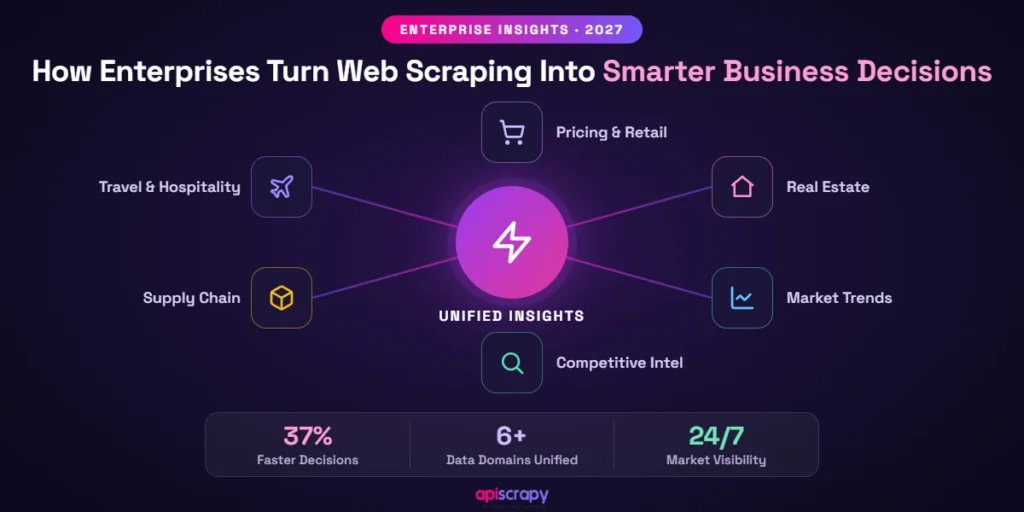
Enterprise teams can no longer afford to make major decisions using yesterday’s data. Web scraping turns publicly available information—from competitor pricing and marketplace activity to search results and emerging market signals—into timely intelligence that teams can actually act on. But collecting the data is only the beginning; the real advantage comes from building a reliable pipeline that keeps information accurate, structured, and ready for analysis as conditions change
- Pricing and revenue teams: Scrape competitor prices, stock, and promotions continuously to power repricing that reacts in days or hours, not weekly spreadsheet cycles.
- Strategy and market research teams: Track product listings, job postings, and category growth to catch demand shifts before industry reports do.
- Product and AI teams: Feed models fresh, real-world web data, but only after it is cleaned, deduplicated, and mapped to a clear business question.
- Watch the risks: Legal compliance, anti-bot defenses, site layout changes, and silent data drift all demand ongoing attention, not one-time setup.
- Choose a provider on five factors: Scale and reliability, compliance and governance, data accuracy checks, customization, and clear SLAs with transparent support.
- Build or buy: If maintaining scrapers is pulling engineers away from analysis, a managed service like APISCRAPY can carry that load.
Enterprise decision-making has shifted from quarterly reports to real-time signals pulled directly from the web. Pricing teams, market researchers, and product leaders no longer wait for an industry report to tell them what already happened. They pull the data themselves, as it happens, from competitor sites, marketplaces, and public sources.
This shift is why web scraping has moved from an engineering side project to a board-level conversation. The global web scraping market is on track to pass 1.5 billion dollars in 2026, with analysts projecting it will more than double again by 2030. Growth like that does not happen because scraping is trendy.
This article breaks down exactly where web scraping earns its place in enterprise strategy:
- Where enterprises are seeing measurable business value from scraped data
- The real challenges that come with running web scraping at enterprise scale
- What separates a scraping service worth trusting from one that becomes a liability
A quick disclosure: APISCRAPY, a managed web scraping and data-as-a-service company, is referenced later in this piece as one option among several. The intent here is to help you make the right call for your business, not to sell one path.
Whether you build in-house or work with an external service, the decisions below apply the same way. What matters most is getting reliable data into the hands of the people who act on it.
Why Businesses Need Web Scraping
At its core, web scraping gives businesses continuous visibility into information that lives outside their own systems. It turns public web pages, listings, and reviews into structured data feeds that decision-makers can actually query. That visibility is what separates companies reacting to the market from companies anticipating it.
Teams that rely on this data day to day include:
- Pricing and revenue teams running dynamic repricing models
- Competitive intelligence and strategy analysts
- Market research groups tracking category and demand shifts
- Procurement teams comparing supplier and vendor data
- Product and AI teams that need fresh, real-world training data
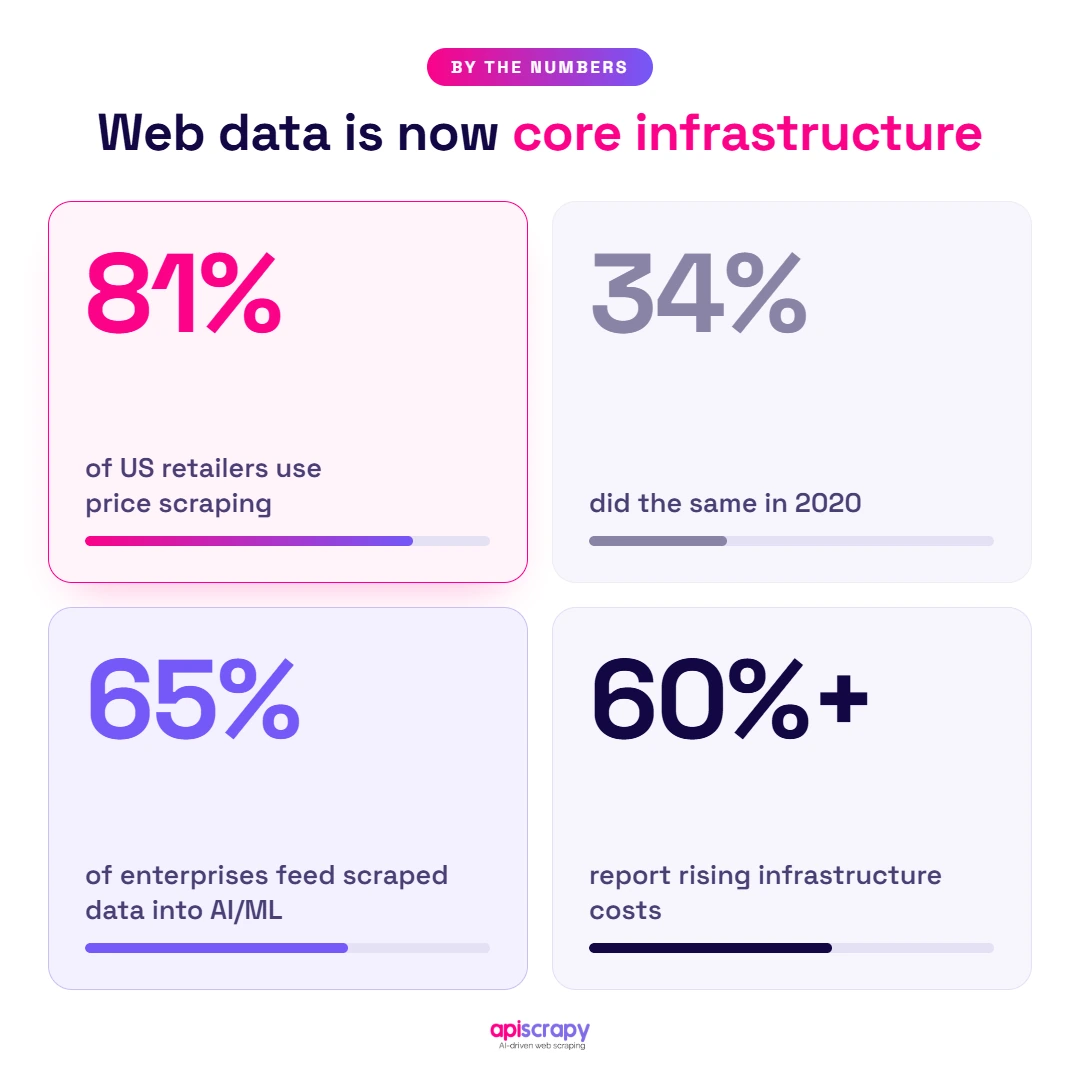
In real workflows, this data feeds weekly pricing reviews, market entry decisions, demand forecasting models, and vendor comparisons. Sixty-five percent of enterprises already use scraped web data to feed AI and machine learning projects, a figure that keeps climbing as more decisions become automated.
Key Takeaways and Use Cases for Web Scraping That Help Business
Competitor and Pricing Monitoring
Retailers and marketplaces scrape competitor pricing continuously to power dynamic repricing engines rather than manual spreadsheet checks. Eighty-one percent of US retailers now run some form of automated price scraping, up sharply from 34 percent in 2020.
Key takeaway: Real-time price monitoring turns pricing from a quarterly exercise into a daily competitive advantage.
Market Trend and Growth Opportunity Identification
Enterprises scrape product listings, job postings, and marketplace category data to spot demand shifts before competitors do. This works especially well in real estate, e-commerce, and travel, where inventory and pricing update by the hour.
Key takeaway: Scraped market signals can surface expansion opportunities months before traditional research catches up.
Turning Scraped Data Into Actionable Insight
Raw scraped data only becomes useful once it is cleaned, deduplicated, and mapped to a specific business question. Enterprises pair scraping with structuring and validation layers so analysts receive ready-to-use datasets, not raw HTML.
Key takeaway: The business value sits in the pipeline from raw page to structured insight, not in the scrape itself.
Data Accuracy and Reliability for Decision-Making
Enterprises increasingly treat data freshness and accuracy as a service-level requirement rather than a nice-to-have. Automated validation, deduplication, and change detection catch broken or stale feeds before they reach a dashboard.
Key takeaway: A pricing or forecasting model is only as reliable as the freshest data feeding it.
What Challenges and Considerations Do Organizations Face in Web Scraping?
Web scraping behaves differently at enterprise scale than it does for a single analyst pulling data by hand. What starts as a quick internal script often turns into an ongoing maintenance burden the moment a target site changes its layout or adds new bot defenses.
Legal and compliance considerations sit at the top of that list. Enterprises need to respect robots.txt directives, site terms of service, and regional data protection rules, especially when scraping spans multiple countries.
Technical friction follows closely behind. Anti-bot measures, JavaScript-heavy pages, and constant site structure changes mean scraping systems need continuous engineering attention just to stay functional.
Data quality is the third pressure point. Duplicate records, outdated listings, and silent structural drift on target sites can quietly corrupt a dataset long before anyone notices it in a report.
More than 60 percent of scraping professionals reported rising infrastructure costs year over year, largely driven by adaptive site defenses, according to the 2026 State of Web Scraping report from Apify and The Web Scraping Club. That is engineering time spent on evasion instead of analysis, which is exactly the cost enterprises are trying to avoid.
How Should Enterprises Choose the Right Web Scraping Service Provider?
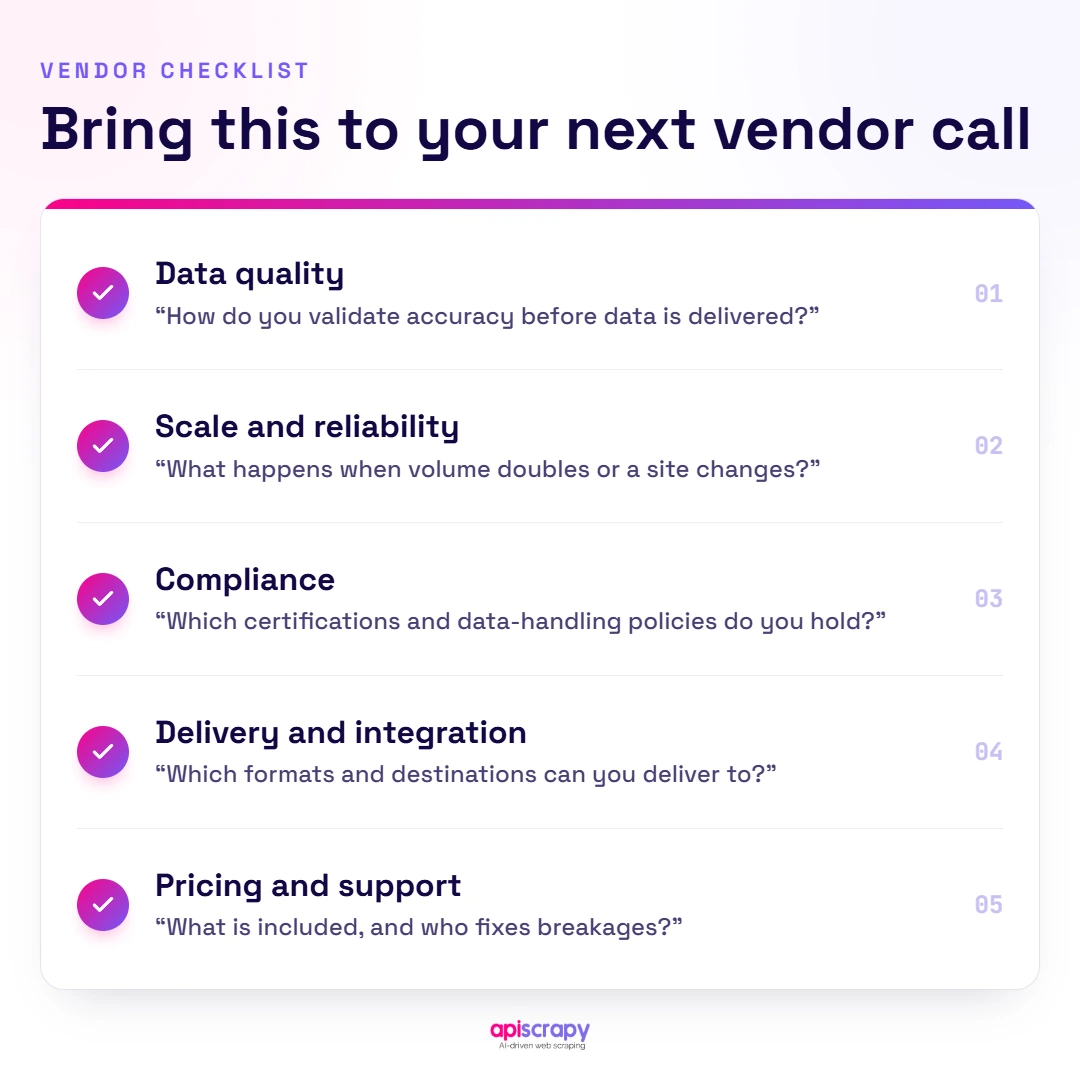
Scale and Infrastructure Reliability
A service needs to demonstrate it can hold up under enterprise data volumes without frequent downtime or silent failures.
Compliance and Data Governance
Look for documented handling of robots.txt, regional regulations, and ethical data sourcing practices, not just a mention in a sales conversation.
Data Accuracy and Quality Assurance
Ask how the service validates, deduplicates, and flags anomalies before data reaches your systems. Raw extraction without validation simply shifts that work back onto your team.
Customization and Integration Flexibility
Your service provider should adapt to your specific data schema and delivery format rather than forcing your team to rebuild pipelines around theirs.
Support, SLAs, and Vendor Transparency
Enterprise scraping breaks occasionally no matter who runs it. What matters is whether the provider tells you fast and fixes it faster, backed by a clear service-level agreement.
Services like APISCRAPY build their managed offering around these five factors, pairing infrastructure reliability with compliance-first data sourcing.
Start Building Your Web Crawler Today
Conclusion
Web scraping has moved well past its reputation as a technical shortcut. For enterprises, it is now a direct input into pricing strategy, market expansion, and product decisions that used to rely on lagging reports.
The challenges are real. Compliance, technical maintenance, and data quality all demand ongoing attention rather than a one-time setup. Choosing the right service, whether built in-house or managed externally, determines whether scraped data becomes a competitive edge or a maintenance headache.
As more business decisions become automated, the enterprises that treat web data as core infrastructure, not an afterthought, will be the ones moving faster than their competitors.
See how a managed approach handles this at scale. Book a demo with APISCRAPY and get a clear look at your data pipeline in under thirty minutes.
Frequently Asked Questions About Enterprise Web Scraping
How Are Enterprises Using Web Scraping to Monitor Competitors and Make Better Pricing Decisions?
Enterprises scrape competitor websites and marketplaces continuously to track price changes, stock levels, and promotions as they happen. This feeds repricing engines that can adjust prices within minutes instead of days.
The result is dynamic pricing built on live market conditions rather than static spreadsheets updated once a week.
What Business Data Should Enterprises Scrape to Identify Market Trends and New Growth Opportunities?
Product listings, category growth, job postings, and review volume all signal where demand is shifting before it shows up in industry reports. Real estate, retail, and travel businesses track these signals closely.
Combined with historical data, these signals help teams identify underserved markets and emerging categories months ahead of competitors relying on lagging research.
How Can Enterprises Turn Scraped Web Data Into Actionable Insights for Smarter Business Decisions?
Raw scraped pages need cleaning, deduplication, and structuring before they answer a real business question. Enterprises pair scraping with validation layers that map data directly to metrics like price index or market share.
Without that structuring step, scraped data stays as noise, since the business value sits in the pipeline, not the page itself.
How Do Enterprises Ensure Web Scraping Data Is Accurate, Up to Date, and Reliable Enough for Business Decisions?
Enterprises rely on automated validation, deduplication, and change detection to catch broken or stale feeds before they reach a dashboard. Scheduled refresh cycles keep data aligned with how fast the target site actually changes.
Treating data freshness as a measurable service-level requirement, not an assumption, is what keeps downstream models trustworthy.