What Are the Challenges and Benefits of Amazon Web Scraping?

What Are the Challenges and Benefits of Amazon Web Scraping?
Amazon continues to dominate the global e-commerce landscape, boasting approximately 350 million active users worldwide as of 2024. This enormous customer base makes Amazon a premier source of e-commerce data, providing an unparalleled opportunity for marketers, retailers, and product developers to gain deep market insights and fine-tune their strategies effectively. Nevertheless, Amazon web scraping involves navigating a complex environment with multiple layers of defenses designed to safeguard its data.
For businesses and data analysts, understanding these challenges—and the benefits enabled by effective data extraction—is crucial to making well-informed decisions. In this comprehensive guide, we will explore the nuances of Amazon web scraping, analyze its key benefits and challenges supported by current data and expert insights, and provide best practices to help you execute your Amazon web scraping projects successfully and compliantly.
What is Amazon Web Scraping?
Amazon web scraping refers to the automated process of extracting diverse pieces of data from Amazon’s website, such as product metadata, pricing details, user reviews, and inventory status. Businesses, fintech entities, and market researchers harness scraping technologies to monitor market conditions, track competitor activities, and tailor product offerings to consumer preferences.
However, it is paramount to understand that Amazon’s Terms of Service explicitly restrict unauthorized scraping to protect data privacy and platform integrity. This means that while scraping offers significant strategic value, compliance and thoughtful technique selection are vital to mitigate legal and operational risks.
As Damon Silver, CTO of Data Insight Company, notes: “Utilizing Amazon scraping tools offers indispensable market intelligence but requires a balanced approach that respects legal frameworks and ethical use of data.” (Forbes, 2023)Employing efficient and compliant Amazon web scraping tools enables actionable insights, fostering smarter business decisions while upholding Amazon’s terms and legal stipulations.
Why Extract Data from Amazon?
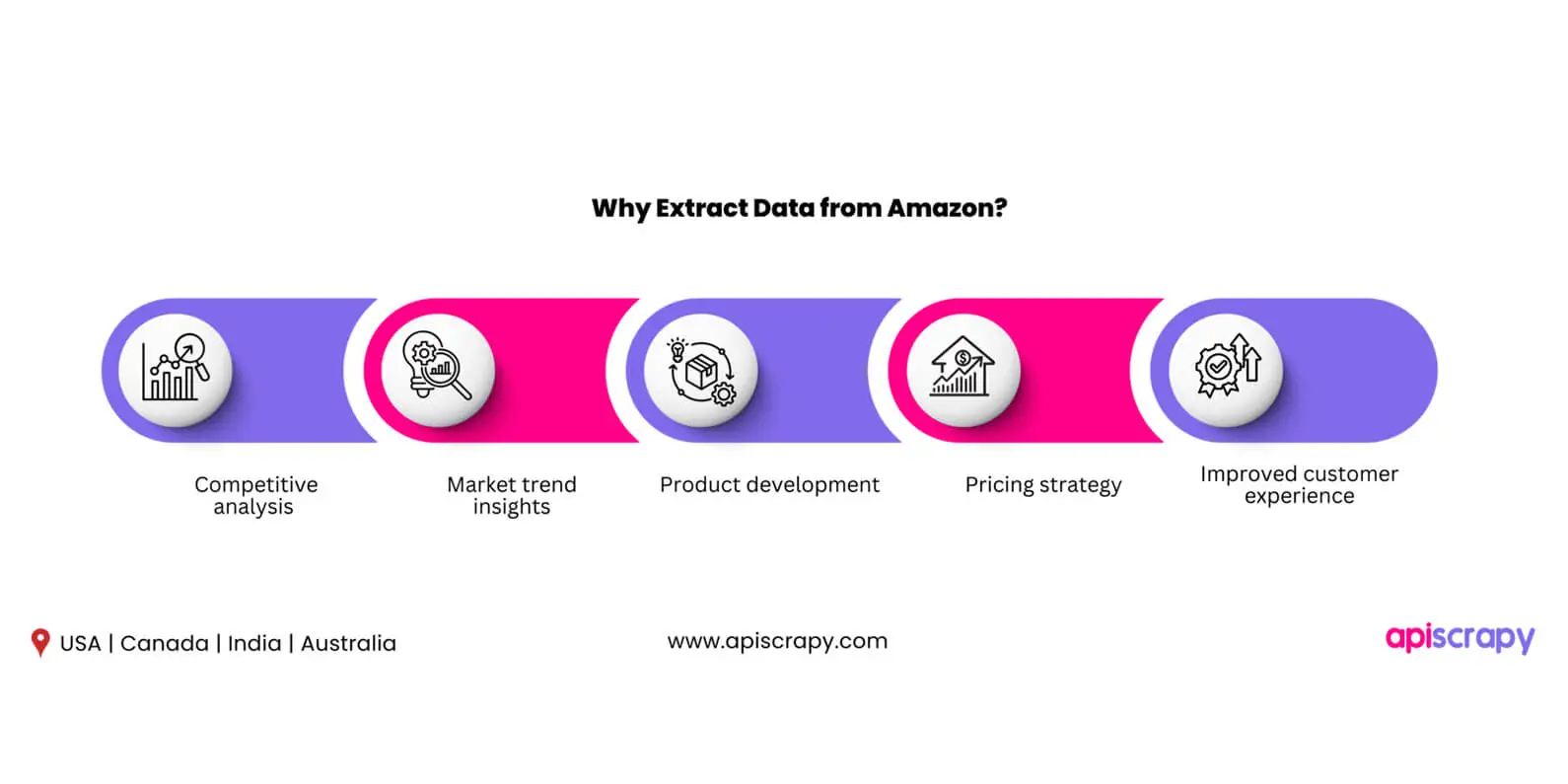
With over 650 million products listed on Amazon as of early 2024 [Forbes], Amazon represents a colossal repository of live e-commerce data crucial for business growth. Extracting this data offers strategic advantages, including but not limited to:
- Competitive analysis: Monitoring competitors’ pricing strategies, product ranges, and consumer feedback allows dynamic strategy adjustments that maintain or elevate market positioning.
- Market trend identification: Scrutinizing Amazon’s data uncovers emerging product trends, evolving consumer demands, and seasonal fluctuations. This insight empowers businesses to anticipate shifts and tailor offerings promptly.
- Product development: Leveraging customer reviews and sales data guides refinements and innovations, enabling businesses to align product design strictly with consumer expectations.
- Pricing optimization: Access to live market price points through Amazon price scrapers supports real-time optimization, balancing attractiveness and profitability.
- Enhanced customer experience: Understanding customer sentiments through review analysis informs product quality improvements and service enhancements.
As McKinsey’s 2023 Retail Report underscores: “Data extracted from e-commerce giants like Amazon is foundational to predictive market modeling and accelerated product innovation.” This reflects the growing strategic role of web scraping in competitive modern retail.
See these use cases in action
Book a walkthrough with our data team
What type of data can be scraped from Amazon?
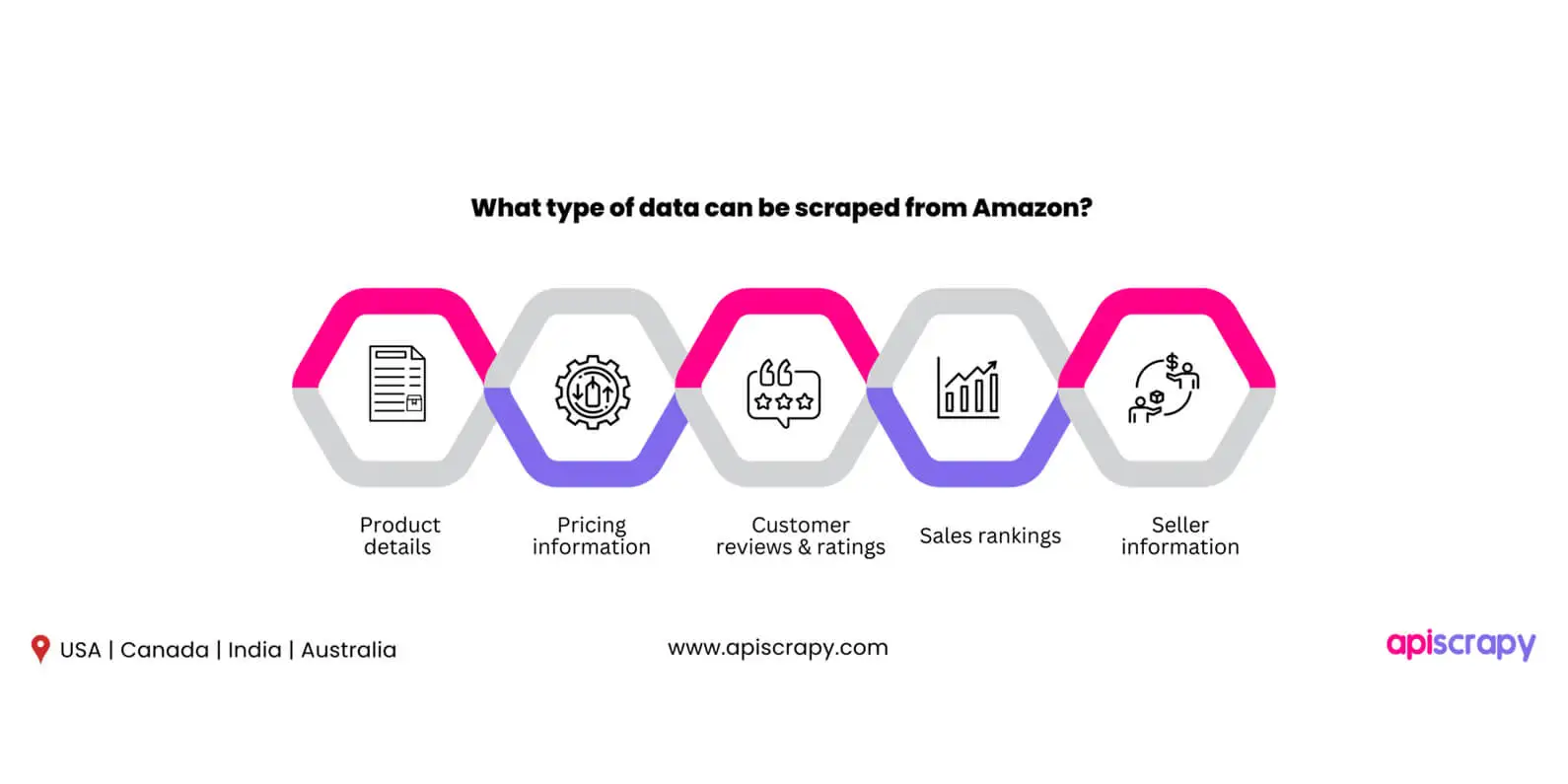
Amazon’s extensive product database yields multiple actionable data types for scraping, including:
- Product details: Titles, descriptions, specifications, images, and categorizations serve as baselines for comparative analyses and optimizing own product listings.
- Pricing information: Continuous price monitoring helps capture market movements and competitor tactics to adjust pricing strategies responsively.
- Customer reviews and ratings: Synthesizing consumer feedback reveals strengths and weaknesses, enhancing quality control and customer satisfaction.
- Sales rankings: Product rank visibility informs about market demand and guides inventory prioritization.
- Seller information: Profiling competitors’ vendors and their marketing tactics facilitates tactical sales positioning and competitive benchmarking.
Leveraging these diverse datasets fortifies a business’s ability to make data-driven decisions spanning product development and marketing campaign configuration.
What Are the Challenges of Amazon Web Scraping?
While the lure of Amazon’s data is undeniable, scraping the website is fraught with significant challenges. Understanding these difficulties upfront enables better preparation and risk mitigation.
1. Bot detection, CAPTCHA, and IP blocking
To shield its data, Amazon deploys advanced bot detection algorithms designed to differentiate human users from automated scraping agents. Measures frequently encountered include:
- Complex CAPTCHAs are triggered upon detecting automated patterns to confirm human authenticity.
- IP blocking and rate limiting, which restrict or prevent access upon high-volume or suspicious request activities.
Amazon’s defense system employs machine learning to adapt and improve detection, making illicit scraping increasingly difficult over time.
“One of the biggest challenges in scraping enterprise-level sites is evading anti-bot technology without violating ethical standards, which demands sophisticated technical solutions and responsibility.” – Maya Patel, CTO, Web Data Experts (TechCrunch, 2024)
How to bypass Amazon CAPTCHA or IP bans?
Effective anti-detection strategies include:
- Using rotating proxies to cycle IP addresses and diffuse request origins.
- CAPTCHA-solving services automate verification challenges promptly.
- Simulating human browsing behaviors by throttling request frequencies and using randomized task sequences.
- Employing headless browsers that can replicate human browser interactions and JavaScript execution.
These approaches, when deployed ethically and judiciously, can help maintain uninterrupted, reliable data extraction.
2. Legal restrictions
Amazon explicitly forbids unauthorized automated scraping within its Terms of Service – violation can lead to bans or legal action. Furthermore, data privacy regulations — notably the EU’s GDPR and the California Consumer Privacy Act (CCPA) effective into 2024-25 — impose stringent controls over personal data handling. Noncompliance risks fines, reputational damage, and operational disruptions.
How to overcome legal restrictions?
- Thoroughly review Amazon’s Terms of Service and relevant legislation before beginning any scraping activity.
- Consult experienced legal counsel to align your processes with regulatory requirements.
- Prefer official channels such as Amazon’s Advertising API and MWS to source data lawfully.
- Explore partnerships like affiliate programs that offer access to lawful data streams.
This ensures your scraping initiatives are legally safe, ethical, and sustainable.
3. Data management complications
Handling vast volumes of scraped Amazon data introduces logistical complexities, including:
- Secure, scalable data storage solutions to accommodate a continuous influx.
- Regular data cleaning and normalization to ensure accuracy and usability.
- Automated updates to reflect volatile product and pricing changes.
Without a robust data infrastructure, organizations risk operational bottlenecks and data staleness.
How to overcome data management complications?
- Utilize cloud-based databases and data warehouses (e.g., AWS, Azure) for scalability.
- Deploy data pipelines equipped with ETL (extract, transform, load) tools for automation.
- Regularly update scraping scripts to adapt to Amazon’s layout and policy changes.
- Implement data quality and governance frameworks to assure integrity and compliance.
4. Varying product page structures
Amazon frequently revises page layouts and customizes display formats by product categories, complicating scraping. Scrapers must adjust dynamically to:
- Algorithmically identify varying HTML structures.
- Handle pagination, embedded widgets, and dynamic content.
The constant website evolution necessitates flexible and responsive scraping tools.
How to overcome varying product page structures?
- Build scrapers using advanced selectors (XPath, CSS selectors) adaptable to different DOM elements.
- Integrate machine learning models to detect and adjust to structural variations.
- Schedule frequent maintenance and script testing to preempt data extraction failures.
- Use scraping services with continuous monitoring and updates for resilience.
5. Product variations
Amazon products often exhibit multiple variations — by size, color, and accessories — each with its own pricing and availability. Capturing these nuances requires intricate scraping logic. Incomplete variation data leads to partial insights, compromising decision accuracy.
How to overcome product variations?
- Develop scrapers with capabilities to interact dynamically with selection dropdowns and variant selectors.
- Use an automated interface Simulation (e.g., Selenium) to mimic user inputs.
- Store variant metadata systematically to retain granular detail and relevance.
6. Difficult to design an Amazon Scraper
Due to Amazon’s robust anti-scraping technologies, dynamic content, and vast heterogeneity of product pages, building a resilient bespoke scraper is technically daunting and resource-intensive.
How to come up with a reliable Amazon Scraper?
Leveraging managed services like APISCRAPY offers compelling advantages:
- Pre-built tools optimized for Amazon’s complexities: handling CAPTCHAs, proxy rotation, and adaptive parsers.
- Infrastructure to scale scraping efficiently without frequent rebuilding.
- Expert support for compliance and ethical scraping.
According to industry leader Irina Kolesnikova, CEO of APISCRAPY: “Our managed scraping solutions empower businesses to unlock Amazon’s wealth of data safely, reliably, and at scale.” (LinkedIn, 2024)
Does Amazon Support Web Scraping?
Amazon’s Terms of Service generally prohibit unauthorized scraping. To operate well within legal frameworks:
- Review Amazon’s terms thoroughly to comprehend permissible practices.
- Obtain explicit permissions where possible through direct communication or formal agreements.
- Use Amazon’s official APIs like the Advertising API and Marketplace Web Service, designed to provide sanctioned data access.
- Collaborate with professional scraping services versed in ethical and legal data acquisition.
When done carefully, businesses mitigate the risks of penalties and ensure operational continuity.
What Are the Benefits of Amazon Web Scraping?
Delving into Amazon’s multifaceted data realm offers a spectrum of actionable benefits:
You get competitive pricing insights
Amazon price scrapers provide real-time, granular competitor pricing data to:
- Align your prices precisely with market realities.
- Instantly react to competitor discounts or surges.
Example: If headphones from competitors hover at $50, pricing yours at $47 could increase sales conversion. This strategy reflects real-time market intelligence empowering adaptive pricing.
You understand and analyze the market trend
Scraping reveals emerging market trends, enabling proactive innovations:
- Identification of increasing demand for eco-friendly phone accessories guides sustainable product development.
- Insight into subscription boxes’ rising popularity drives curated offers.
As Gartner’s 2024 Consumer Behavior Study reveals: “E-commerce data mining sharpens companies’ agility in aligning with rapidly shifting consumer preferences.”
You get a chance to optimize your product
Analyzing top performers’ features informs enhancements
- Studying bestselling laptops’ traits like battery longevity and portability guides your own product improvements.
This data-driven product refinement boosts competitive edge and customer satisfaction.
You understand customer sentiment
Amazon review scraping extracts authentic feedback:
- E.g., if kitchen appliance users frequently request quieter machines, R&D can target noise reduction.
Direct customer insights from reviews are invaluable for quality control and marketing narratives.
You get insights into inventory management
Scraping stock availability data reveals demand fluctuations, aiding supply chain agility:
- Anticipating summer grill shortages enables proactive inventory boosting.
- Prevents lost sales due to stockouts by matching supply with patterns.
This level of inventory intelligence enhances profitability.
You get data to build your SEO and content strategy
By analyzing trending keywords and product popularity on Amazon:
- Develop targeted blog content focusing on consumer interests (sustainable living, tech gadgets).
- Boost organic traffic with data-backed keywords.
A HubSpot 2024 study confirms: “Data-driven SEO outperforms conventional strategies by 27% in conversion efficiency.”
You get empowered to enhance the ad targeting plan
Targeted advertisement is enhanced by user data harvested from Amazon:
- Discover high-purchase demographics for fitness trackers individually.
- Tailor ads accordingly for improved ROI and engagement.
Precision ad targeting directs budget to the most receptive audiences for maximum campaign impact.
Does Amazon Support Web Scraping?
Amazon’s Terms of Service generally prohibit unauthorized scraping. To operate well within legal frameworks:
- Review Amazon’s terms thoroughly to comprehend permissible practices.
- Obtain explicit permissions where possible through direct communication or formal agreements.
- Use Amazon’s official APIs like the Advertising API and Marketplace Web Service, designed to provide sanctioned data access.
- Collaborate with professional scraping services versed in ethical and legal data acquisition.
When done carefully, businesses mitigate risks of penalties and ensure operational continuity.
What Are the Benefits of Amazon Web Scraping?
Delving into Amazon’s multifaceted data realm offers a spectrum of actionable benefits:
You get competitive pricing insights
Amazon price scrapers provide real-time, granular competitor pricing data to:
- Align your prices precisely with market realities.
- Instantly react to competitor discounts or surges.
Example: If headphones from competitors hover at $50, pricing yours at $47 could increase sales conversion. This strategy reflects real-time market intelligence, empowering adaptive pricing.
You understand and analyze the market trend
Scraping reveals emerging market trends, enabling proactive innovations:
- Identification of increasing demand for eco-friendly phone accessories guides sustainable product development.
- Insight into subscription boxes’ rising popularity drives curated offers.
As Gartner’s 2024 Consumer Behavior Study reveals, “E-commerce data mining sharpens companies’ agility in aligning with rapidly shifting consumer preferences.”
You get a chance to optimize your product
Analyzing top performers’ features informs enhancements:
- Studying bestselling laptops’ traits like battery longevity and portability guides your own product improvements.
This data-driven product refinement boosts competitive edge and customer satisfaction.
You understand customer sentiment
Amazon review scraping extracts authentic feedback:
- E.g., if kitchen appliance users frequently request quieter machines, R&D can target noise reduction.
Direct customer insights from reviews are invaluable for quality control and marketing narratives.
You get insights into inventory management
Scraping stock availability data reveals demand fluctuations, aiding supply chain agility:
- Anticipating summer grill shortages enables proactive inventory boosting.
- Prevents lost sales due to stockouts by matching supply with patterns.
This level of inventory intelligence enhances profitability.
You get data to build your SEO and content strategy
By analyzing trending keywords and product popularity on Amazon:
- Develop targeted blog content focusing on consumer interests (sustainable living, tech gadgets).
- Boost organic traffic with data-backed keywords.
A HubSpot 2024 study confirms: “Data-driven SEO outperforms conventional strategies by 27% in conversion efficiency.”
You get empowered to enhance the ad targeting plan
Targeted advertisement is enhanced by user data harvested from Amazon:
- Discover high-purchase demographics for fitness trackers individually.
- Tailor ads accordingly for improved ROI and engagement.
Precision ad targeting directs budget to the most receptive audiences for maximum campaign impact.
Which Method to Choose for Amazon Web Scraping?
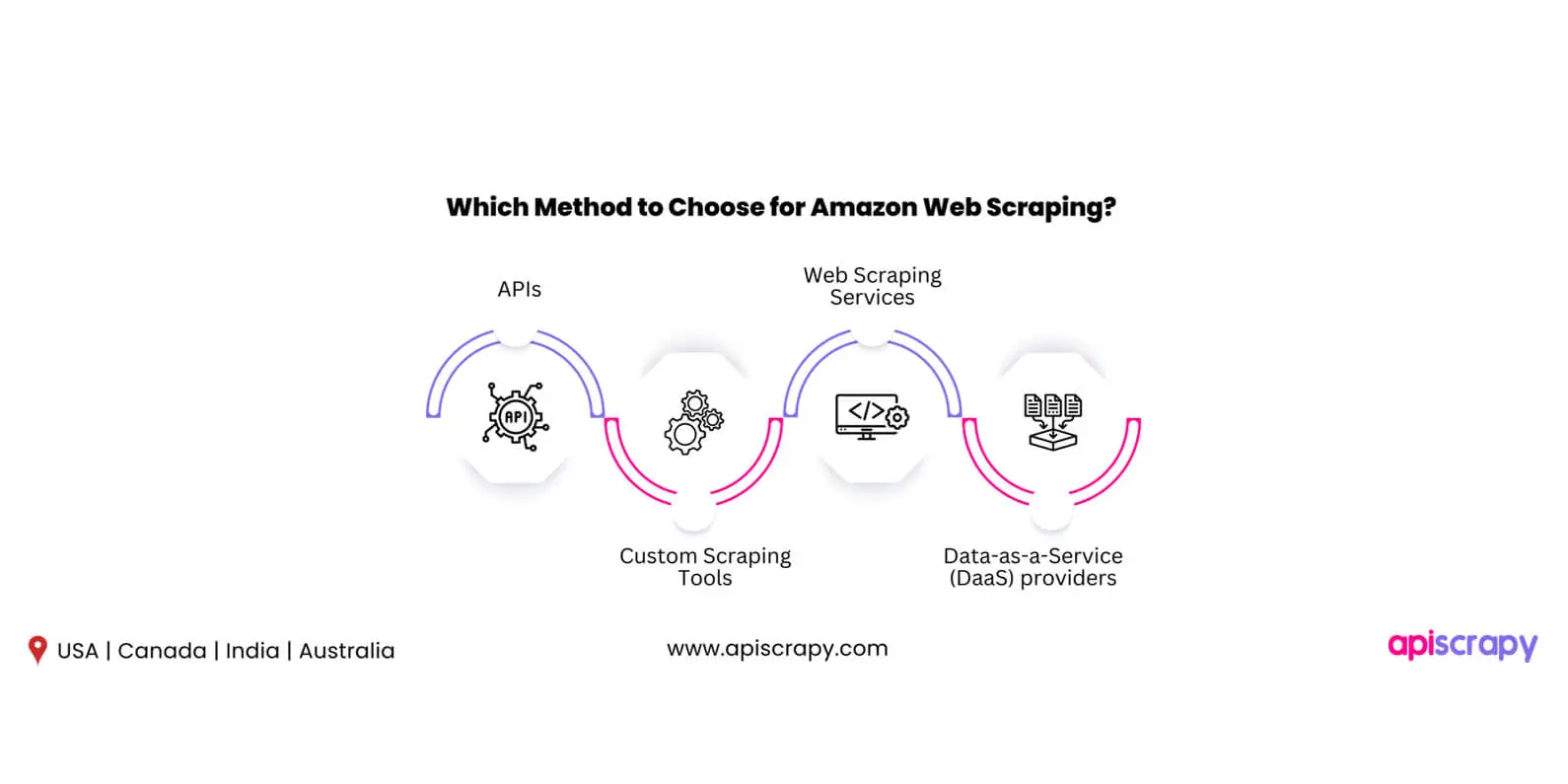
Selecting your approach depends on business goals, technical capabilities, and legal considerations.
APIs
Amazon provides official APIs such as:
- Amazon Advertising API
- Amazon Marketplace Web Service (MWS)
Advantages:
- Full compliance with Amazon policies.
- Reliable, structured data.
- Technical support and documentation.
Limitations:
- Restricted data access depending on user approval.
- Request limits may apply.
Custom Scraping Tools
Standalone scripts built with libraries like:
- BeautifulSoup, Scrapy, Selenium
Advantages:
- Full customization.
- Total control over data extraction.
Requirements:
- Advanced programming skills.
- Continuous maintenance, adapting to site changes.
Web Scraping Services
Providers like APISCRAPY deliver turnkey scraping solutions:
- Address Amazon’s protective measures.
- Provide scalability and management.
- Ensure compliance and avoid legal traps.
Cost:
- Higher up-front or subscription expense.
Data-as-a-Service (DaaS) Providers
Buy curated Amazon data:
- Provider manages data collection and delivery.
- Ready-to-use datasets.
Considerations:
- Pricing may be high.
- Dependency on the provider for updates.
- May lack customization.
Choosing Smartly: Businesses with limited technical resources and a focus on compliance often find APIs or managed services most practical. Firms with demanding, custom data needs and internal capacity may opt for building proprietary scrapers.
To Sum Up
Amazon web scraping unlocks critical market intelligence, fueling enhanced pricing, marketing, product innovation, and operational decisions. Despite inherent challenges such as legal frameworks, anti-bot measures, and data management, navigating these with expert tools like APISCRAPY can maximize impact safely. For competitively thriving businesses in 2024 and beyond, tapping into Amazon’s data ecosystem responsibly and strategically is essential. Explore how APISCRAPY’s Amazon web scraping services can simplify these complexities and propel your growth.
Learn more