What Is AI Data Extraction? The complete guide
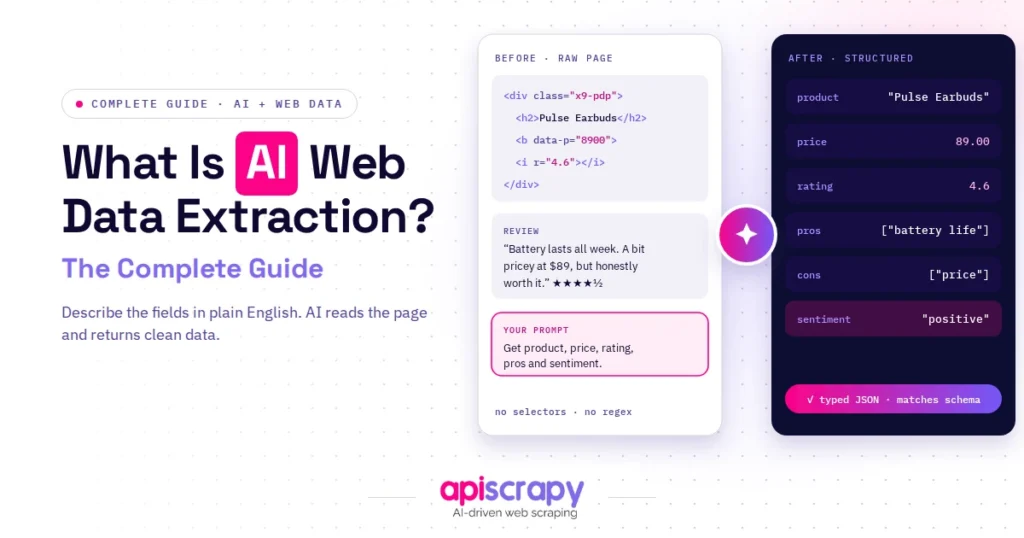
- AI data extraction understands the meaning behind content, not just its structure. Unlike rule-based scrapers that rely on fixed patterns, it identifies relevant information contextually, helping your data pipelines stay resilient even when website layouts change.
- Self-healing replaces constant rewrites. Adaptive selectors and self-healing crawlers detect broken extraction logic and correct it automatically, cutting down the engineering hours traditional scraping demands after every site redesign.
- JavaScript-heavy pages are handled natively. Where traditional scraping often needs added rendering tools bolted on, AI-powered extraction handles dynamic content as part of its core process.
- The real signal to switch is time spent on maintenance, not accuracy alone. If a team spends more hours fixing broken scrapers than analyzing the data itself, or sources are too inconsistent for fixed rules, that’s when AI extraction earns its keep.
- Build versus buy still depends on scale and bandwidth. In-house extraction gives full control but demands ongoing engineering ownership, while a managed service shifts that maintenance burden elsewhere for teams that need reliable data without growing an internal function.
Websites today are built for people, not for scripts. Pages load content dynamically, layouts change without notice, and older scraping methods struggle to keep pace with this complexity.
This guide explains what AI web data extraction is, how it works, and where it fits, so you can decide if it is the right approach for your data needs.
In this guide, you will learn:
- What AI data extraction means and how it differs from traditional scraping
- How the underlying process actually works, step by step
- Where businesses are using it across industries
- The real benefits and the situations where it makes the most sense
- How to decide between building in-house or using a managed service
Managed services such as APISCRAPY are referenced in this guide as examples of how the approach works in practice. This is meant to inform, not to promote any single option.
The goal here is simple: help you understand the concept clearly enough to make the right call for your own team, whether that means building, buying, or doing nothing yet.
What Is AI Data Extraction?
AI data extraction is the process of using machine learning and language models to pull structured information from web pages, documents, or unstructured text automatically.
Unlike older methods that rely on fixed rules for each page, AI-based extraction understands content contextually, so it keeps working even when a page’s layout changes.
This matters now because most websites are no longer simple HTML. They load content through JavaScript, personalize layouts, and update frequently, which breaks rule-based scrapers.
Core Components of AI Data Extraction
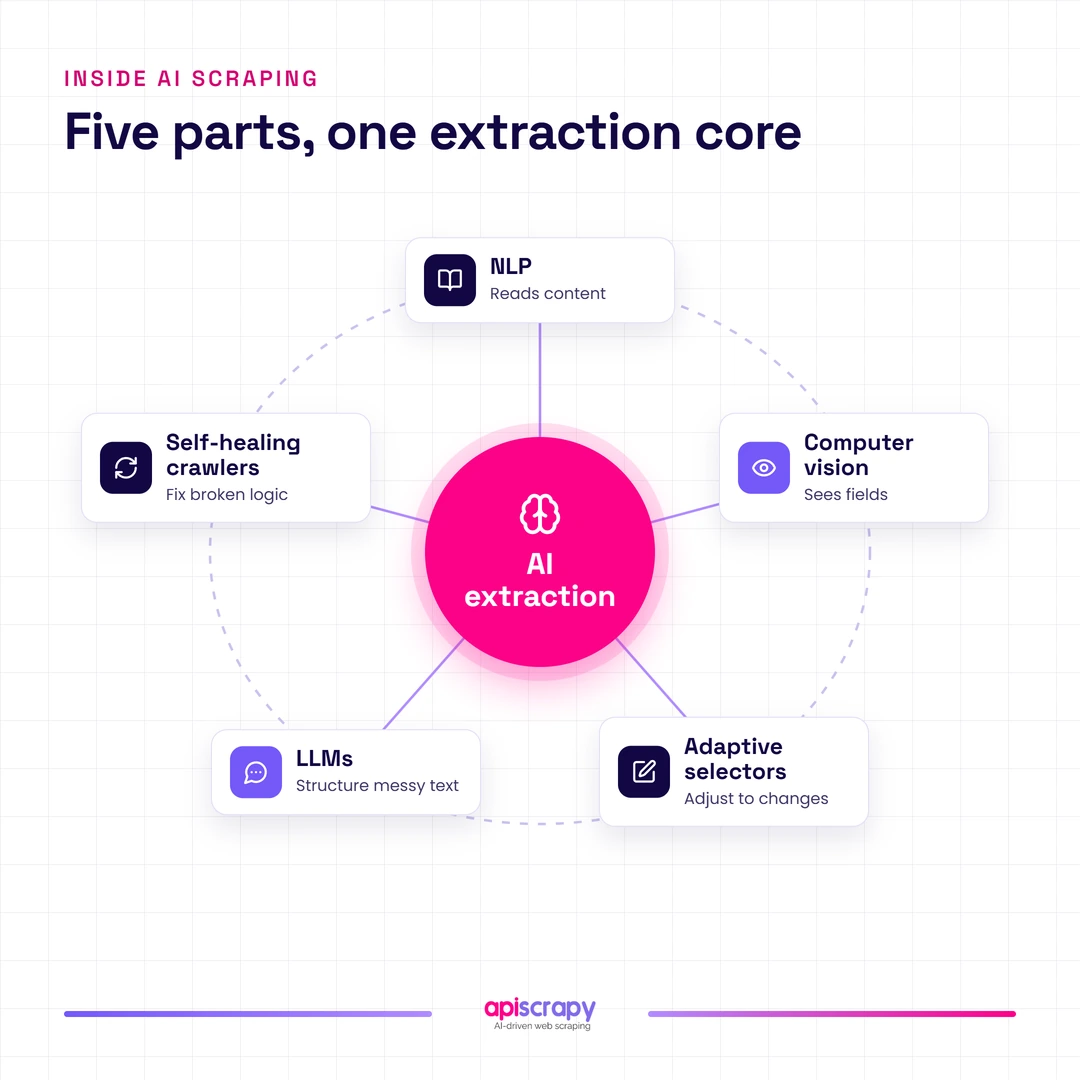
- Natural language processing that reads and interprets page content rather than matching fixed patterns
- Computer vision models that identify data fields visually, similar to how a person scans a page
- Adaptive selectors that adjust automatically when a website’s structure changes
- Large language models that convert messy, unstructured content into clean, structured output
- Self-healing crawlers that detect broken extraction logic and correct it without manual intervention
How Does AI Data Extraction Work?
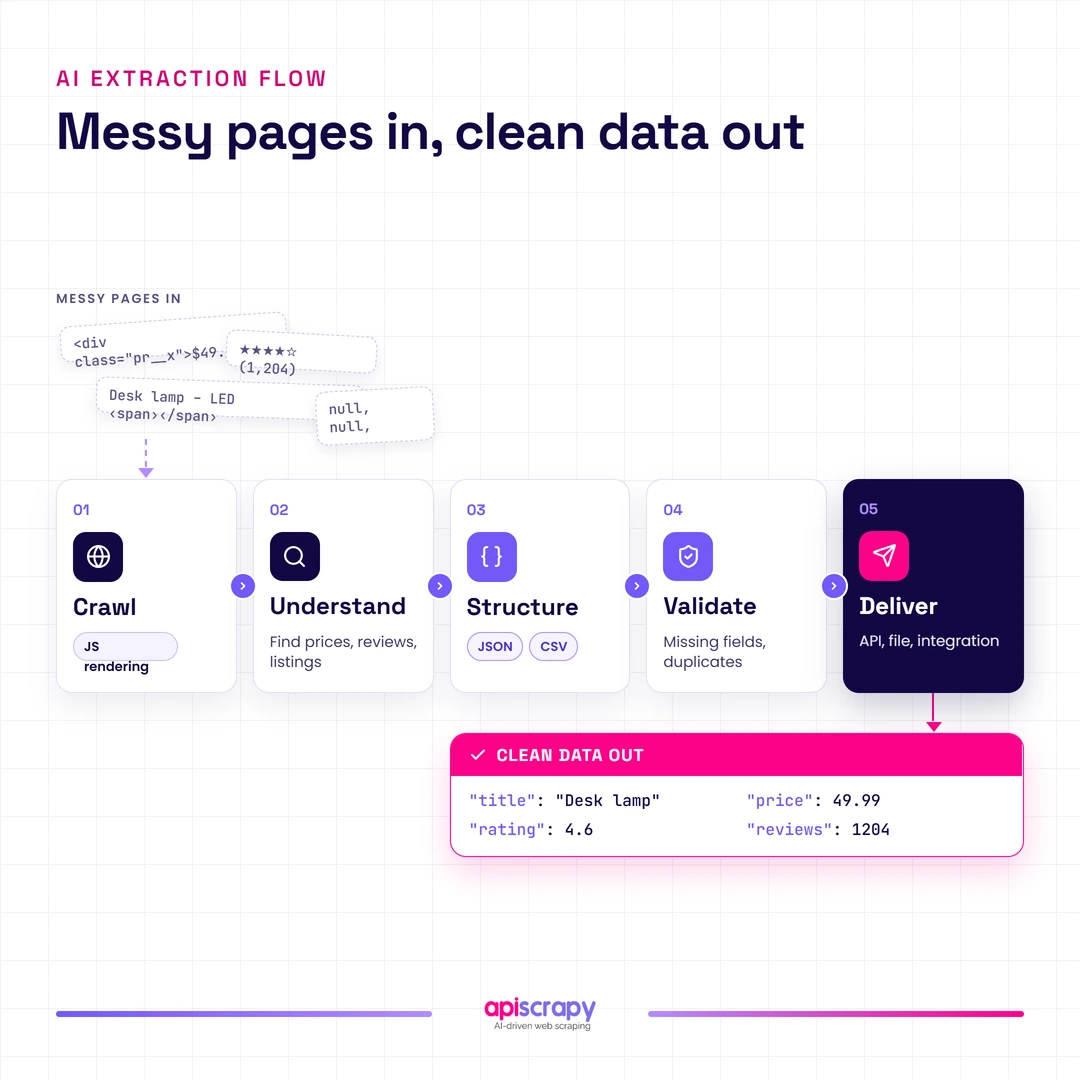
At a high level, the process moves from raw web pages to clean, usable data in a few connected steps.
- Crawling: the system visits target pages, including those requiring JavaScript rendering
- Content understanding: models identify relevant fields such as prices, reviews, or listings
- Structuring: extracted content is converted into a consistent format such as JSON or CSV
- Validation: automated checks catch missing fields, duplicates, or formatting errors
- Delivery: structured data is delivered through an API, file, or direct integration
The outcome is the same regardless of how messy or inconsistent the source pages are: clean, structured data that is ready to use without manual cleanup.
What Are the Common Use Cases and Services?
AI data extraction supports a wide range of business functions where accurate, up-to-date information matters.
- Price monitoring across e-commerce and retail websites
- Lead generation from business directories and public listings
- Market and competitive research using product and review data
- Real estate listing aggregation across multiple portals
- Review and sentiment aggregation from multiple review sites
Many businesses handle this through managed services like APISCRAPY rather than building extraction pipelines internally, particularly when data needs span multiple sources at scale.
Traditional vs AI Data Extraction: The Differences
The table below compares the two approaches across the factors that matter most in practice.
| Factor | Traditional Scraping | AI-Powered Extraction |
|---|---|---|
| Setup effort | Requires custom scripts per site structure | Adapts to page layout with minimal manual coding |
| Handling layout changes | Breaks and needs rewrites | Self-adjusts using pattern recognition |
| Dynamic or JS-heavy pages | Often needs added rendering tools | Handles JavaScript rendering natively |
| Output structure | Raw HTML needing manual parsing | Clean, structured data ready for use |
| Maintenance over time | Ongoing engineering hours | Lower maintenance once trained |
Where Are Businesses Actually Using AI Data Extraction Today?
E-commerce
Retailers track competitor pricing and product availability across thousands of listings that change daily, something manual scripts cannot keep up with.
Real Estate
Agencies aggregate listings from multiple portals into a single feed, handling inconsistent formats and frequent layout changes across sites.
Finance
Analysts extract structured data from filings, news, and market pages to feed models that need current, reliable inputs.
Travel
Platforms monitor fares and availability across airline and hotel sites that rely heavily on dynamic, JavaScript-rendered content.
Recruitment
Staffing services pull job postings and candidate data from multiple boards into one structured pipeline for faster matching.
What Are the Benefits of Using AI Data Extraction?
- Higher accuracy on messy or inconsistently formatted pages compared to rigid rule-based scripts
- Resilience to layout changes, reducing the need for constant script rewrites
- Lower ongoing engineering maintenance since extraction logic adapts on its own
- Structured output that is ready to feed directly into AI and analytics pipelines
- Better handling of JavaScript-heavy and dynamically loaded pages without added tooling
When Should You Use AI-Powered Data Extraction?
AI-powered extraction makes the most sense when your data sources are inconsistent, frequently updated, or too varied for fixed rules to handle reliably.
If most of your target sites rely on JavaScript rendering, a rule-based scraper will likely require constant patching just to keep functioning.
It also fits when your team is spending more time maintaining broken scrapers than analyzing the data itself, or when you need extraction to scale across many different source formats at once.
Finally, if the extracted data is meant to feed downstream AI or LLM systems, structured and consistent output becomes a requirement rather than a nice-to-have.
What Is the Best Way to Extract Data Using AI?
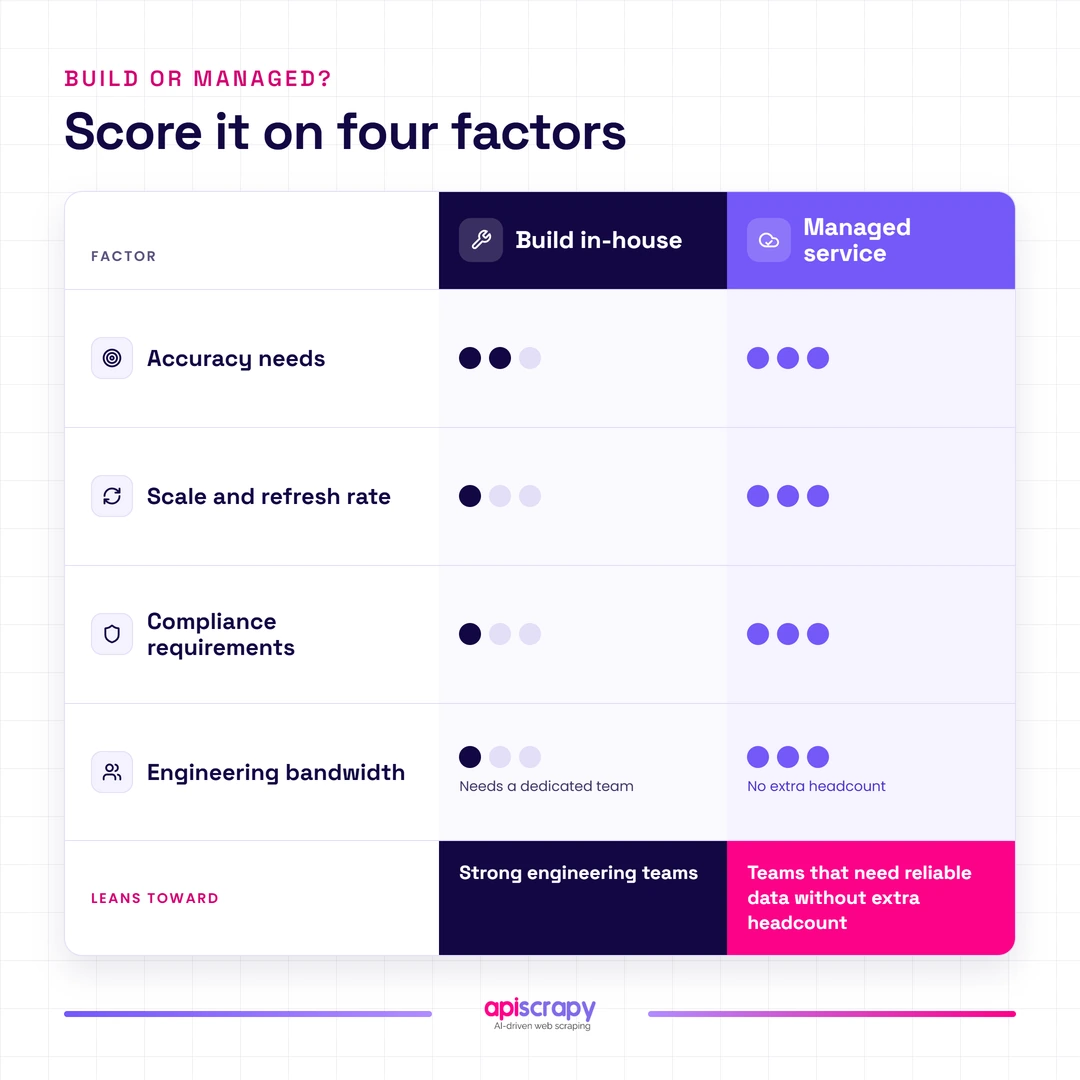
The core decision comes down to building extraction capability in-house or relying on a managed service to handle it.
Building in-house gives full control but requires ongoing engineering time, infrastructure, and ownership of maintenance as target sites evolve.
Using a managed service such as APISCRAPY shifts that maintenance burden elsewhere, which tends to suit teams that need reliable data without growing an internal engineering function.
- Accuracy requirements for the specific data fields you need
- Scale, meaning how many sources and how frequently data must be refreshed
- Compliance and data handling requirements specific to your industry
- Available internal engineering bandwidth to build and maintain extraction logic
There is no single correct answer here. The right approach depends on your scale, timeline, and how much internal resource you can commit to maintaining it.
Start Building Your Web Crawler Today
Conclusion
AI data extraction solves problems that traditional scraping increasingly cannot, particularly as websites become more dynamic and inconsistent in structure.
Whether you build in-house or work with a managed service, the right choice depends on your own scale, technical resources, and how critical uninterrupted data flow is to your business.
If you want to see how a managed approach handles this in practice, book a demo to walk through your specific data needs with a team that works on this daily.
Frequently Asked Questions
Is AI-extracted data as accurate as traditionally scraped data?
AI extraction handles complex or inconsistent pages more accurately, though simple stable structures work fine with traditional scraping too.
How much does AI data extraction cost compared to traditional scraping?
Traditional scraping seems cheaper upfront but adds costs through maintenance, while AI extraction offers more predictable pricing tied to volume.
What industries and use cases rely most on AI web data extraction?
E-commerce, real estate, finance, travel, and recruitment lead usage, mainly for price monitoring, listing aggregation, and market research.
Can AI extraction handle JavaScript-heavy or dynamic websites better than traditional scrapers?
Yes, AI-powered extraction handles JavaScript-heavy and dynamic pages more reliably than rule-based scraping methods.
Is scraped web data safe and compliant to use for AI training?
Compliance depends on the data source, type, and applicable regulations rather than the extraction method used.
Should a business build AI scraping in-house or use a managed data extraction service?
In-house suits teams with strong engineering resources, while a managed service like APIScrapy suits those wanting reliable data without infrastructure overhead.